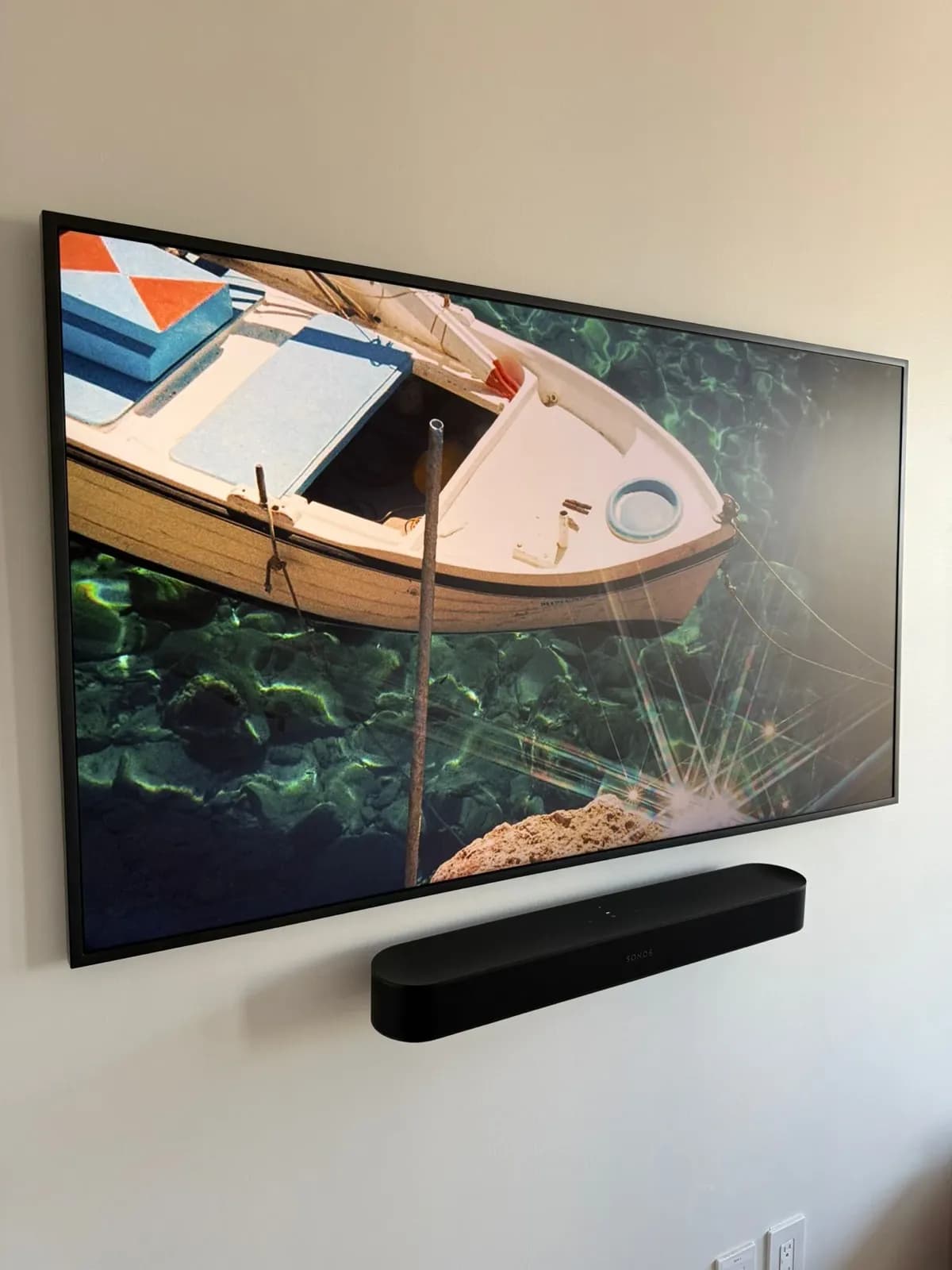
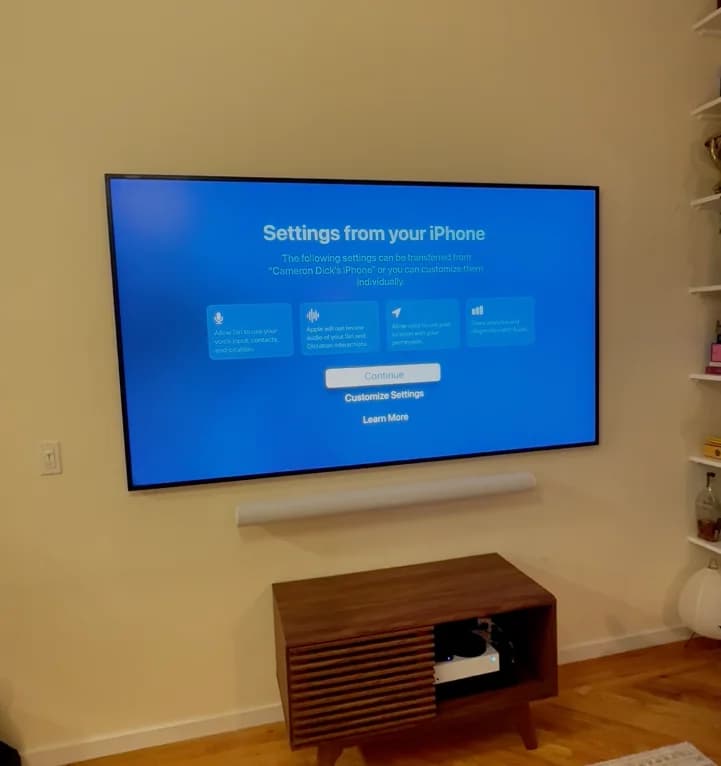

One owner on Reddit says they replaced a soundbar with a receiver and separate speakers in a new living room. Read what owners say ↓
What owners on Reddit say
"New living room setup, moved away from a Samsung Q930C soundbar setup with wireless rears and sub. Denon AVRX2800H receiver, SVS PB-1000 Pro sub, KEF Q7 Meta floorstanders, KEF Q6 Meta centre, KEF Q1 surrounds." — one owner, r/hometheater (thread)
Some owners start with a soundbar and move to separate speakers later. A soundbar still suits many rooms.
Who's this for: Anyone deciding between a soundbar and a full surround sound system for their NYC home.
This guide tells you when a soundbar wins, when surround sound is worth it, and how to grow your setup over time without committing to everything at once.
Whatever you choose, the install matters as much as the gear. We can wall-mount your soundbar and TV cleanly, or design a full home theater installation for a dedicated room. Ready to plan it? Book your appointment online — your final price depends on the services and options you choose plus the distance from Midtown Manhattan, and you'll see the estimated total before you submit your booking request.
On this page
How a soundbar works
A soundbar is one long enclosure that sits below your TV. It packs multiple small speakers into a single bar. Entry-level bars handle left, center, and right channels. Better bars add upward- and side-firing drivers that bounce sound off the ceiling and walls to simulate height and surround effects — that's how a single bar can advertise "Dolby Atmos."
Most soundbars pair wirelessly with a separate subwoofer for bass. Many let you add wireless rear speakers later. The entire wiring story: one bar, one cable to the TV, one power outlet, and a subwoofer that just needs its own outlet.
Setup is fast, the footprint is tiny, and a good bar with a sub is a massive improvement over your TV's built-in speakers — which are thin because there's no room for real drivers inside a flat panel.
How surround sound works
True surround sound uses physically separate speakers placed around the room, powered by an AV receiver (the central box everything plugs into). A 5.1 system has five speakers — front left, center, front right, two rears — plus one subwoofer. A 7.1.4 system adds side speakers and four ceiling speakers for overhead Dolby Atmos.
Because each speaker is real and independently placed, sound is genuinely directional. A helicopter pans behind you. Rain falls from above. No amount of clever bouncing from a single bar matches a real speaker behind your couch.
The trade-off is everything a soundbar avoids: a receiver in your media console, speaker wire running to every corner, speaker stands or wall brackets, and careful calibration. More capable, and more involved.
Soundbar vs 5.1 vs 7.1.4: the comparison
| Factor | Soundbar (+ sub) | 5.1 Surround | 7.1.4 / Home Theater |
|---|---|---|---|
| Speakers | 1 bar + 1 sub | 5 speakers + sub | 11+ speakers + sub, incl. ceiling |
| Wires | 1 cable to TV + power | Speaker wire to 4 corners | Wire to walls + ceiling; in-wall ideal |
| Cost tier | $ (entry to premium bars) | $$ (receiver + 5 speakers) | $$$$ (dedicated room, starting from $10,000) |
| Immersion | Good — simulated surround | Real directional surround | Full cinema with overhead height |
| Apartment-friendly | Excellent — minimal footprint | Moderate — visible speakers/wire | Needs a dedicated room |
| Neighbor / noise | Easy to keep controlled | Sub bass travels; manageable | Best in a sealed, treated room |
| Install time | Short | Half-day to a day | Multi-day, custom |
Every step up buys more immersion — at the cost of more wiring, more visible hardware, and more potential to bother the neighbors. The right choice is about your room and your building, not which one is "best."
NYC apartment realities
NYC is its own audio environment. Three local realities push most renters and owners toward a soundbar.
Thin walls and shared buildings. Surround sound's strength — bass and rear channels filling a room — is exactly what travels through prewar plaster and into your neighbor's bedroom. A soundbar with a subwoofer at sensible volume is far easier to enjoy at apartment-friendly levels, especially at night. If you do run a sub, isolation feet and a corner placement away from shared walls help a lot.
Renting limits wiring. Running speaker wire to four corners usually means drilling, fishing wire through walls, or stapling raceway along baseboards — not ideal (or allowed) in most rentals. A soundbar needs one cable to the TV, which we can conceal cleanly. If you want rears, wireless surround speakers skip the wiring problem entirely.
Wall types complicate in-wall runs. Many NYC apartments have plaster, brick, or concrete behind the walls. In-wall cable routing only works reliably on drywall. Everywhere else, you're looking at surface raceways or going wireless. This is the same constraint we cover in our guide to hiding TV cables in NYC apartments — it shapes what's realistic for surround speakers too.
Upgrade paths: start small, grow later
One of the best things about modern soundbars is that you don't have to commit to everything at once. A smart sequence:
- Soundbar alone. Instantly better than TV speakers. Clean, simple, one wire.
- Add a wireless subwoofer. The single biggest upgrade — real bass for movies and music without running any wire. Place it away from shared walls if you have neighbors nearby.
- Add wireless rear speakers. Most premium bars let you add a pair of wireless rears that connect to the same system. Now you have genuine rear-channel surround without a receiver or speaker wire — ideal for apartments. If you have older wired speakers, see our guide on converting wired speakers to wireless.
This path gets you most of the way to real surround sound while staying renter-friendly and neighbor-conscious. For specific gear at each step, run our recommendations tool for a tailored shortlist.
When to go full surround
Stepping up to a wired 5.1 system or a full home theater makes sense when several of these are true:
- You own your place (or have permission to run wires and drill).
- You have a dedicated room — a den, basement, or media room you can darken and control.
- You can place speakers behind and beside the seating without a tripping hazard or eyesore.
- You want real overhead Dolby Atmos height effects — a soundbar can only simulate these. Our Dolby Atmos guide explains what that actually takes.
- Noise is less of a concern — a house, a corner unit, a well-isolated room, or a building where you're not stacked tight against neighbors.
At the top end, a dedicated home theater with in-ceiling speakers, a 4K laser projector, acoustic treatment, and whole-room control is a custom project that starts from $10,000. If that's where you're headed, our overview of how a custom home theater project works walks through what's involved, and we can scope it for your space.
Install considerations
Whatever you choose, a clean install is what makes it look and sound finished.
Soundbar mounting. A bar wall-mounted just below the TV looks unified and frees your console. The included hardware is often too short for NYC metal-stud, plaster, or concrete walls. We cover this in detail in how to mount a soundbar and whether to wall-mount your soundbar. We bring the right anchors for your wall type.
TV placement. Audio follows the screen. If you're planning a new setup, getting the TV mounted at the right height keeps the soundbar and your ears aligned.
Surround speaker placement. Rears and height speakers only deliver when positioned and calibrated correctly. Rears go slightly behind and above ear level; heights aim down at the seating. Wrong geometry = hardware that underperforms.
Cable concealment. The difference between "looks like a store display" and "looks like a teenager's bedroom" is usually the wires. We conceal what we can and route the rest neatly.
Your decision checklist
Run through these five questions and the answer usually picks itself:
- Do you rent or own? Renting leans soundbar (no permanent wiring). Owning opens the door to wired surround.
- Shared walls or standalone room? Shared walls favor a soundbar at controlled volume; an isolated room can handle a full system.
- Can you run wires — or will it be wireless? No wire runs allowed means soundbar plus wireless rears.
- What do you actually watch? Mostly TV, sports, casual movies — a soundbar shines. Dedicated movie nights with overhead effects — surround earns its keep.
- What's your budget and timeline? A bar is fast and affordable today. A home theater is a planned, custom investment.
Still unsure? Call us at (646) 912-5050 and describe your room — we'll tell you honestly which setup fits, with no upsell to gear you don't need.
Frequently Asked Questions
Is a soundbar good enough for a home theater?
For a NYC apartment living room, a good soundbar with a subwoofer is genuinely enough for most people — a massive upgrade over TV speakers, and it handles movies, sports, and music well. For a dedicated home theater where you want true cinema immersion and real overhead Dolby Atmos, full surround speakers outperform any single bar. The right answer depends on the room, not the gear alone.
What's the difference between 5.1 and a soundbar?
A 5.1 system uses five physically separate speakers plus a subwoofer, placed around the room and powered by a receiver — so sound is genuinely directional. A soundbar packs its speakers into one bar and simulates surround by bouncing sound off your walls and ceiling. 5.1 is more immersive; a soundbar is far simpler to install and live with, especially in an apartment.
Will surround sound bother my neighbors in an apartment?
It can, mainly because of the subwoofer — low-frequency bass travels through walls and floors more than any other sound. A soundbar at sensible volume is much easier to keep neighbor-friendly. If you run a sub in an apartment, place it away from shared walls, use isolation feet, and keep the bass level moderate — especially at night.
Can I add surround speakers to a soundbar later?
Often, yes. Many premium soundbars accept a wireless subwoofer and a pair of wireless rear speakers that join the same system — no receiver or speaker wire required. That makes it easy to start with just the bar and grow into a near-surround setup over time, which is ideal for renters and apartments.
What's the best audio setup for a small NYC apartment?
For most small NYC apartments, a soundbar plus a wireless subwoofer is the best balance of sound, footprint, cost, and neighbor-friendliness. Add wireless rears later if you want more immersion. Save a full wired surround system or a dedicated home theater for when you have a room you can wire and a building where noise is less of a concern.
Do I need a professional to install surround sound?
You can place a soundbar yourself, though clean wall mounting in NYC's plaster, metal-stud, or concrete walls is where most people want help. True surround sound — speaker placement, wire routing, and calibration — benefits a lot from professional setup so every channel balances correctly for your seating. We handle both. Book your appointment or call (646) 912-5050 to plan your install.