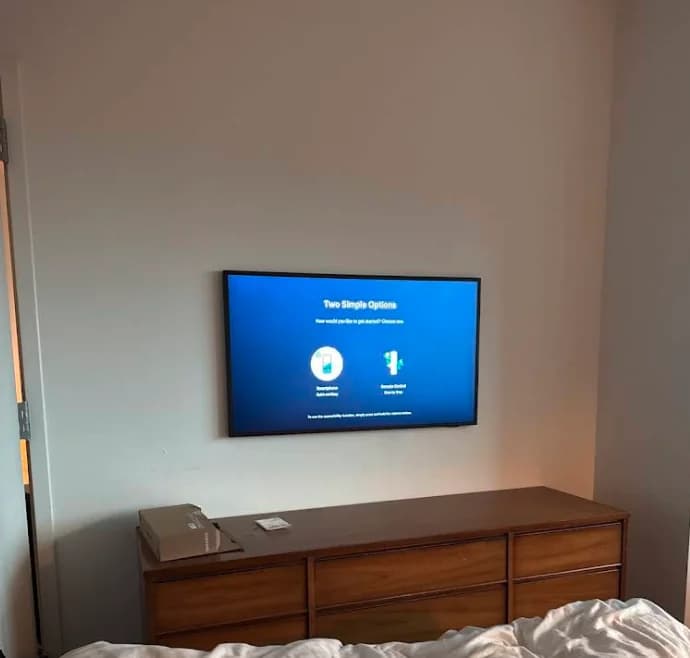
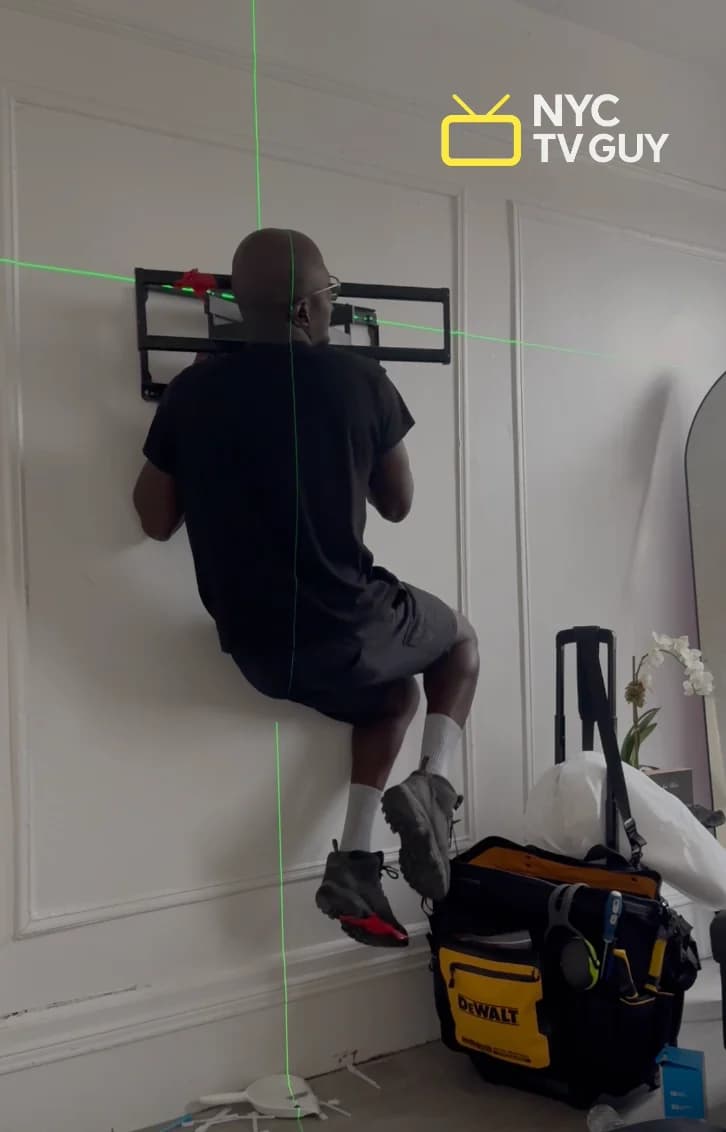
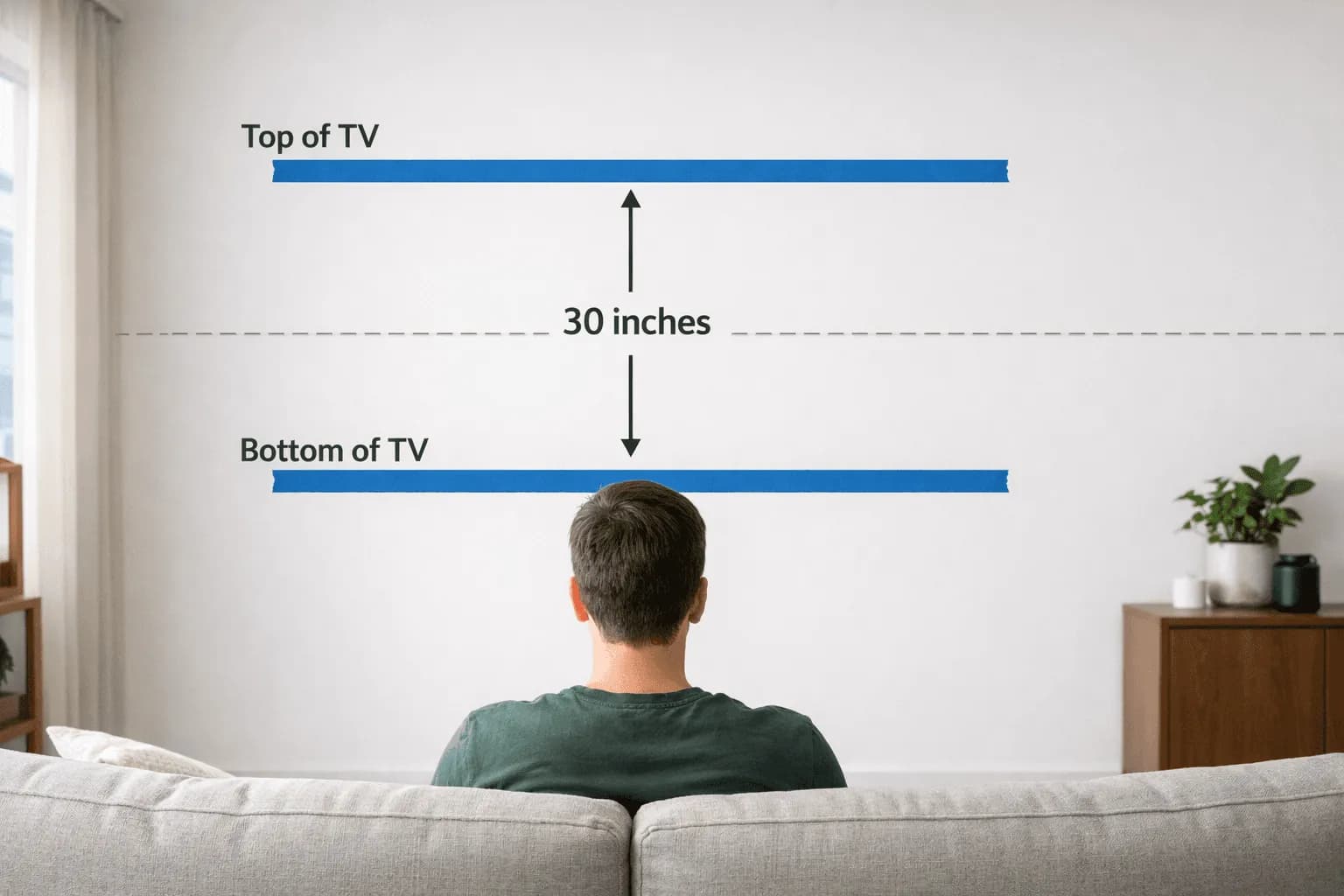
Yes — you can mount a TV in any NYC apartment. Plaster, concrete, drywall, NYCHA. The key is using the right anchors for your wall type.
Is this for you? NYC renters, co-op owners, and condo residents who want to wall-mount a TV and need to know what their walls require.
This guide covers building permissions, every wall type you'll find in NYC, the right mount for each, cable hiding options, and why professional installation is worth it here specifically.
The short answer
- Rentals: Most landlords are fine with it. A few patched holes is normal wear and tear.
- Co-ops/condos: Some require a COI (certificate of insurance) from whoever does the work. We provide one.
- Wall type is everything — plaster, NYCHA cinder block, metal studs, and regular drywall all need different anchors.
- NYCHA: Fixed mount only, max 75-inch TV. Full-motion mounts can pull out of the thinner walls over time.
- We've mounted TVs in 5,000+ NYC apartments and have never been rejected from a building. Book online and we handle everything including COIs.
Do you need permission from your building?
Short answer: most buildings allow it. TV mounting is one of the most common apartment modifications in NYC.
Rentals: Most landlords are fine with it. A TV mount leaves 4–6 holes in the wall, all easily patchable with spackle when you move out. Check your lease for "alterations" language, but in practice this is rarely an issue.
Co-ops and condos: Some buildings require a COI from whoever does the work. That's about it. Send us your building's COI template and we'll send back a completed certificate — we carry general liability and umbrella insurance. We've completed over 5,000 jobs and have never been rejected from a building.
Book your appointment and let us know your building's requirements.
Understanding NYC apartment wall types
This is the most important part. NYC apartment walls are not like walls in the rest of the country. The wrong anchoring approach for your wall type is how TVs end up on the floor.
Pre-war plaster walls (pre-1940s)
If your building was built before World War II, your walls are almost certainly plaster over wood lath.
What to expect: Plaster looks similar to drywall but behaves completely differently. Stud finders can misread through it. Drilling without the right technique cracks the surface.
Mounting approach: Use a deep scanner stud finder to locate studs. For plaster: find studs inside it or use toggle bolts through the wooden lath. Once studs are located, anchor with lag bolts into the wood studs. Magnets do NOT work for finding studs in plaster walls — that trick only works on drywall.
Can you mount on plaster? Yes. Plaster over wood lath is actually very strong when you anchor into the studs. The key is finding those studs correctly — which is where most DIY attempts go wrong.
Post-war concrete and cinder block (1940s–1980s)
Some post-war buildings have concrete or cinder block walls. Most people confuse cement or plaster with concrete — true concrete is usually only external or structural walls.
Mounting approach: You need a hammer drill with carbide-tipped masonry bits. Anchor with concrete screws or sleeve anchors.
NYCHA walls
NYCHA apartments typically have cement or cinder block walls. These are distinct from plaster or standard drywall — and they require a different approach.
The important rules for NYCHA:
- Fixed (flat) mount only — full-motion or articulating mounts put too much leverage on concrete anchors and can pull out over time.
- Maximum TV size: 75 inches.
- The walls are only about 2 inches thick, so there's less material for anchors to grip — which is why the right mount type and hardware matter even more here.
A flat mount distributes the load evenly and holds securely. We mount TVs in NYCHA apartments regularly. Book online and mention your building type in the notes so we bring the right masonry hardware.
New construction and gut renovations in NYC typically use drywall over light-gauge metal studs. You'll find this in:
- New development condos (Hudson Yards, Downtown Brooklyn, LIC)
- Recently renovated apartments in any neighborhood
- Luxury rental buildings built in the last 20 years
What to expect: The walls feel lighter and hollow compared to plaster or concrete. A knock test sounds distinctly different from the solid thud of plaster.
Mounting approach: Metal studs are hollow and flex under load. Use toggle bolts (SnapToggle brand recommended) or through-bolt systems. Do not use standard lag bolts — they'll pull right through the thin metal. This is the wall type where we see the most failed DIY mounts in newer NYC buildings.
Choosing the right TV mount for your apartment
Your wall type determines how much weight it can safely hold, but the mount type matters just as much. Visit our recommendations page for specific mount links based on your setup.
Fixed (flat) mounts — TV sits flush against the wall, no movement. Simplest and most secure. Best for: tight spaces, bedrooms, NYCHA walls.
Tilting mounts — you can angle the TV up or down. Useful when the TV has to go higher than eye level. Best for: above fireplaces, above dressers in bedrooms, kitchens.
Full-motion (articulating) mounts — swivel the TV left and right, tilt up and down, extend out from the wall. Best for: corner installations, open-concept apartments, rooms where you watch from multiple spots. Not recommended for NYCHA walls (walls are only ~2 inches thick).
Getting your security deposit back
Spackling the bolt holes and painting is all it takes. Your building super can usually supply matching paint. Take photos of the wall before mounting for your records.
We offer a TV dismounting service ($175) that includes bracket removal and patching the screw holes with DryDex spackle. Your walls will be move-out ready.
Hiding TV cables in a NYC apartment
Mounting the TV is only half the battle — dangling cables can look worse than no mount at all. You have two main options:
Cable raceway (no wall damage): A paintable plastic channel that covers all cables. Renter-friendly, removable, and included in our TV Mounting + Cables Covered service ($199).
PowerBridge (mid-range option): A recessed power bridge lets you run cables through the wall without a full electrical outlet install. It's a great middle ground between a raceway and a full in-wall solution. We recommend the recessed outlet box specifically for LG and Samsung Frame TVs — but for other TVs, you can usually get away with just the cable-in-wall option below.
For Samsung Frame TVs, we recommend adding a half-inch or one-inch spacer behind the TV to allow airflow — without it, the TV can overheat and burn the wall over time.
In-wall cable routing (cleanest look): All cables run inside the wall with a new outlet behind the TV. Zero visible wires. This is our TV Mounting + Power Outlet + Cable in Wall service ($599). Read our full guide on how to hide TV wires without cutting your wall for all the options.
Why professional installation is worth it in NYC
We're insured. We carry general liability and umbrella insurance. If anything happens during the job — damage to your wall, your TV, anything — we're covered. That's the single biggest reason to hire a professional over a handyman or doing it yourself.
We know your walls. NYC walls are different from the rest of the country. We know immediately whether you have plaster, concrete, metal studs, or NYCHA cinder block — and we bring the right hardware for each. This prevents 90% of failed DIY mounts.
We bring everything. Stud finders, hammer drills, toggle bolt kits, lag bolts, washers, anchors — all of it. A DIY install means buying or renting tools you may never use again.
Our TV mounting service starts at $175. Add cable management for $199 or a full in-wall power outlet for $599. Book online and we'll take care of everything.
Frequently Asked Questions
Can you mount a TV in a NYC rental apartment without losing your deposit?
Yes. A TV mount leaves 4–6 bolt holes that are easily patched with spackle and a coat of paint. Most landlords consider this normal wear and tear, especially if you repair the wall before moving out. Take before-and-after photos for your records. We've mounted TVs in 5,000+ NYC apartments — this is rarely an issue.
Metal studs are hollow and can't hold lag bolts like wood studs. We use heavy-duty SnapToggle bolts that grip the back of the metal stud and distribute the load. Standard drywall anchors and regular lag bolts will fail on metal studs — this is the most common cause of failed DIY mounts in newer NYC buildings.
Do I need a COI (certificate of insurance) to mount a TV in my co-op?
Many co-op buildings require a COI from any contractor doing work in the building. We carry general liability and umbrella insurance and send COIs before or after your deposit — whichever works for your timeline. We've never been rejected in over 5,000 jobs. Just send us your building's COI template and management email address, and we handle the rest.