Mount a bedroom TV lower than you think — because you're lying down, not sitting up. The living-room rules don't apply here.
Is this for you? Anyone placing a TV in a bedroom who wants to avoid waking up with a stiff neck.
This guide covers the exact formula for your height, what to do when mounting above a dresser, and why bigger-and-lower often beats smaller-and-higher.
The short answer
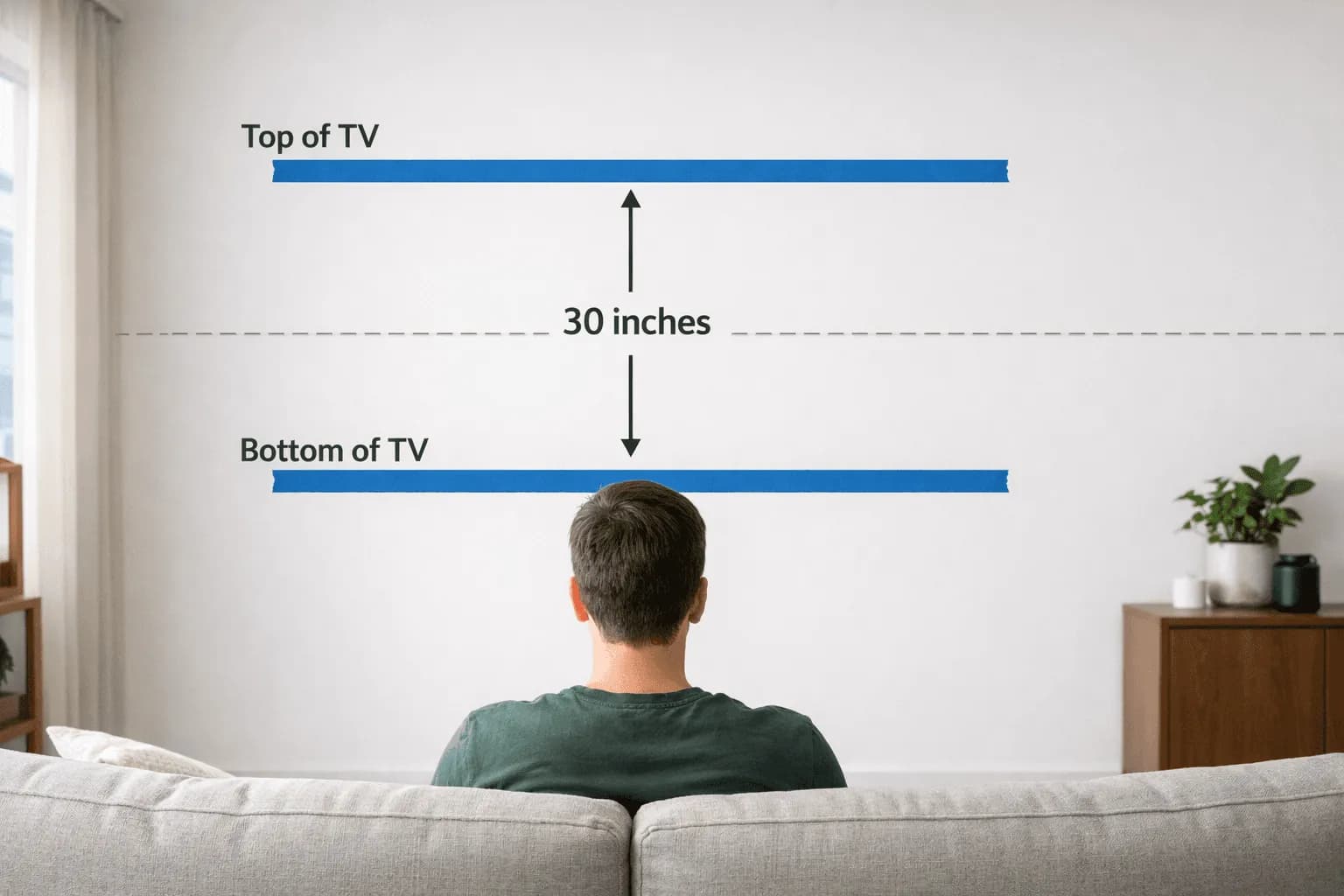
- The formula: Measure your reclined eye height from bed → add 8–14 inches → that's your target TV center height.
- Above a dresser: Almost always needs a tilting mount to angle the screen down toward you.
- Typical result: Most bedrooms land between 36 and 46 inches to the TV center.
- Fastest answer: Use our TV mounting height calculator — enter your setup, get a number instantly.
- Ready to book? Book your bedroom TV mount — tell us your wall, watching position, and outlet location so we come prepared.
The core difference: you're lying down, not sitting up
In a living room, you sit on a couch with your back straight. Your eyes are around 38–48 inches off the floor. A TV centered there is at true eye level.
In a bedroom, you watch from bed. Your head is propped on pillows, angled roughly 30–40 degrees above horizontal. You're not sitting upright — you're nearly flat. Your eyes are lower, and they naturally gaze slightly upward.
The problem: if you use the living-room height, the TV ends up 20–35 degrees above your gaze line. That's uncomfortable after 20 minutes. Most people end up sliding lower in the bed or watching with their neck tilted back.
The goal: a slight upward gaze of about 10–15 degrees. Anything more causes neck strain over time.
Use our TV mounting height calculator for an instant answer, or follow these three steps.
Step 1: Find your reclined eye height
Get into your real watching position — pillows arranged the way you actually use them. Not sitting bolt upright. Your usual setup, 30 minutes into a show.
Have someone measure from the floor to your eyes. For most adults in a typical bed, this is 26–36 inches.
Step 2: Add the offset
Add 8–14 inches to your reclined eye height. This places the TV slightly above true horizontal — right in that comfortable 10–15 degree gaze zone.
Example: Reclined eye height is 30 inches. Add 12 inches. Target center height = 42 inches from the floor.
Walk to the foot of the bed and look at where the TV will go. Picture yourself lying in bed looking at that spot. If you'd need to crank your neck upward, the TV is too high. Trust the formula over your instincts.
Viewing distance in a bedroom
Bedrooms are usually smaller than living rooms. Shorter distance means the same TV size looks much bigger.
Minimum comfortable viewing distance:
- HD content: TV diagonal × 1.5
- 4K content: TV diagonal × 1.0
At 7 feet (84 inches) from the TV:
- HD: max 56-inch TV
- 4K: max 84-inch TV (enormous for a bedroom)
Most bedrooms look best with a 43–55 inch TV. A 65-inch TV in a 10-foot wide room is usually too close for comfortable viewing.
Above the dresser: the most common bedroom setup
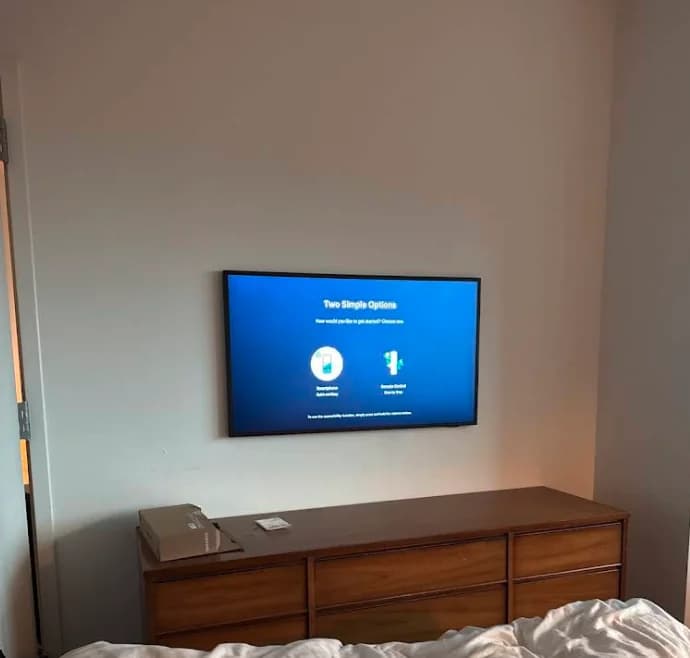
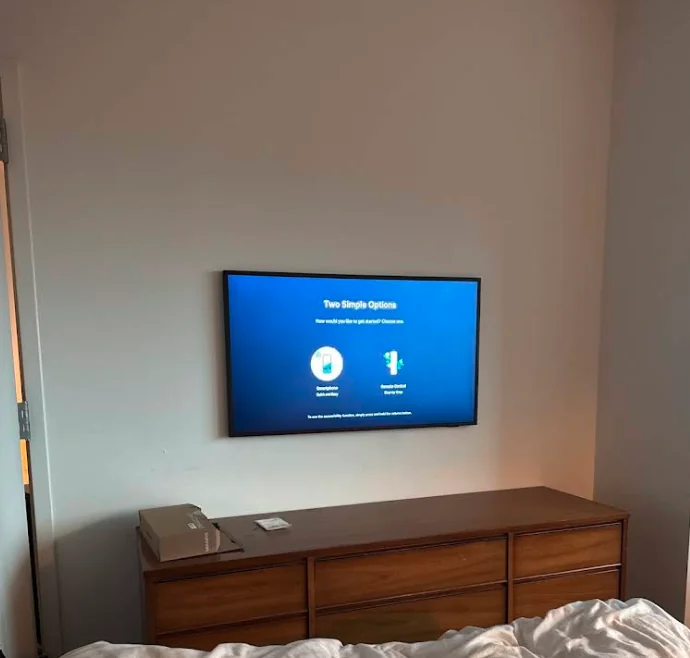
This is what most people end up with — TV above a dresser. It looks clean and uses the dresser as a visual base for the TV.
The catch: a standard dresser is 28–36 inches tall. Add a few inches of clearance, then the TV itself, and the center often lands at 46–58 inches — higher than the formula recommends.
The fix: Use a tilting mount angled 5–10 degrees downward toward the bed. This compensates for the forced height and keeps the angle comfortable.
This is why bedroom TVs almost always need a tilting mount. A fixed mount only works if your height works out perfectly without any furniture below.
The case for lower and bigger
One of the best bedroom setups we install: a larger TV mounted lower than people expect — center at 36–40 inches, with 8–10 feet of viewing distance.
It feels natural for a reclining viewer. It makes the TV feel cinematic instead of like a screen you're squinting at from across the room.
If you can mount on a wall without furniture below it — or use a low-profile floating shelf — go lower and bigger. You'll thank yourself.
Bedroom cable considerations
The outlet-behind-the-dresser problem. In most bedrooms, the outlet is at baseboard height — sometimes blocked by the dresser. Here are your options:
- Power relocation: Install a new outlet behind the TV, fed from the existing outlet through the wall cavity. One clean outlet at TV height, nothing visible.
- Reposition the dresser slightly: Expose the outlet, run a cable down the wall in a narrow raceway, then slide the dresser back.
- Extension cord inside the wall cavity: Do not do this. It's not code-compliant.
Hiding cables from the TV to the dresser surface: If you have components on the dresser top (cable box, Apple TV, game console), a short raceway from the TV mount to the dresser top keeps it tidy and nearly invisible.
What to tell us when you book
When you book a bedroom TV mount, share:
- Which wall (foot-of-bed wall, side wall, etc.)
- Your typical watching position (lying down with pillows, slightly propped up, etc.)
- Whether there's furniture below and how tall it is
- Where your outlet is
This lets us bring the right mount type and cable hardware, and confirm the exact height at the start of your appointment.
Frequently Asked Questions
At 6–8 feet, a 43–50 inch TV is ideal for HD, and 43–55 inch for 4K. Going larger at that distance makes the image too big to scan comfortably — you'll feel like you're inside the screen. The instinct to go as large as possible is usually wrong for bedroom TVs.
Should I get a full-motion mount for a bedroom TV?
Only if there are two very different viewing positions in the same room — like watching from the bed AND from a separate sitting area. For standard bedroom viewing from one spot, a tilting fixed mount is better: cleaner look, more stable, won't get bumped by accident.
Can I use a standard flat mount in a bedroom?
Yes — if your height calculation works out exactly right and you're mounting on a wall with no furniture below (so you pick the height freely). If you're mounting above a dresser, a tilting mount is effectively required.
What if my partner and I have different preferred heights?
Use the measurement that works for the person who watches most often, or split the difference. In most couples, the difference in reclined eye height is small enough that one height works for both.
What about mounting a TV in a kids room?
Kids rooms have different rules — safety comes first. See our guide to mounting a TV in a kids room for the right height, why a fixed flat mount beats tilting, and how to keep cables out of reach.