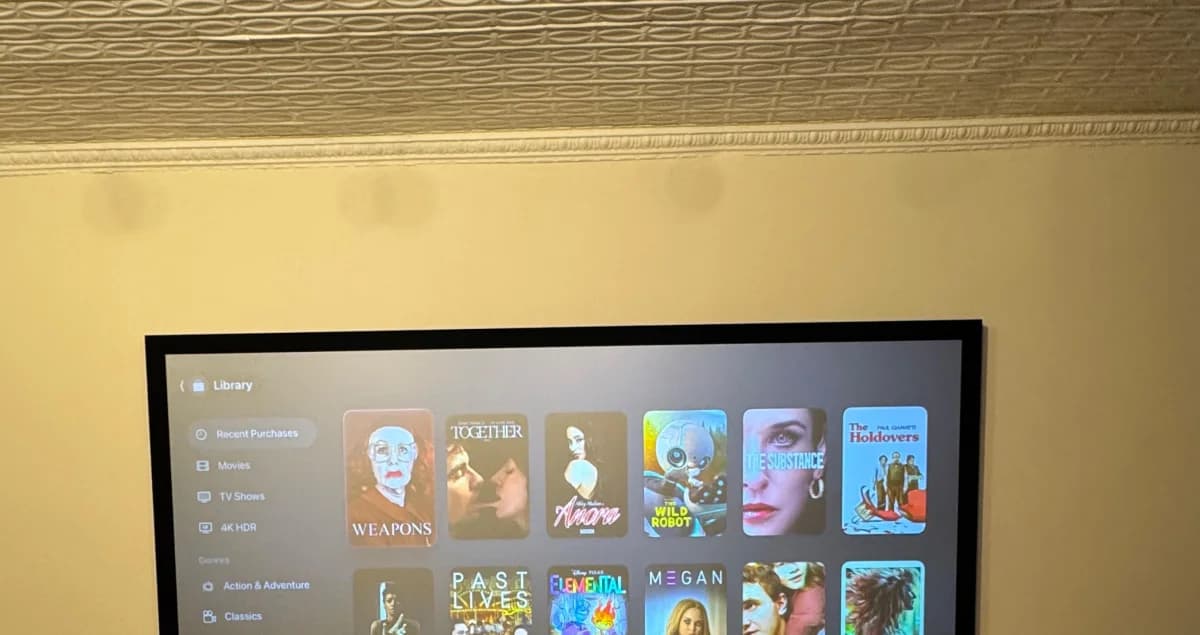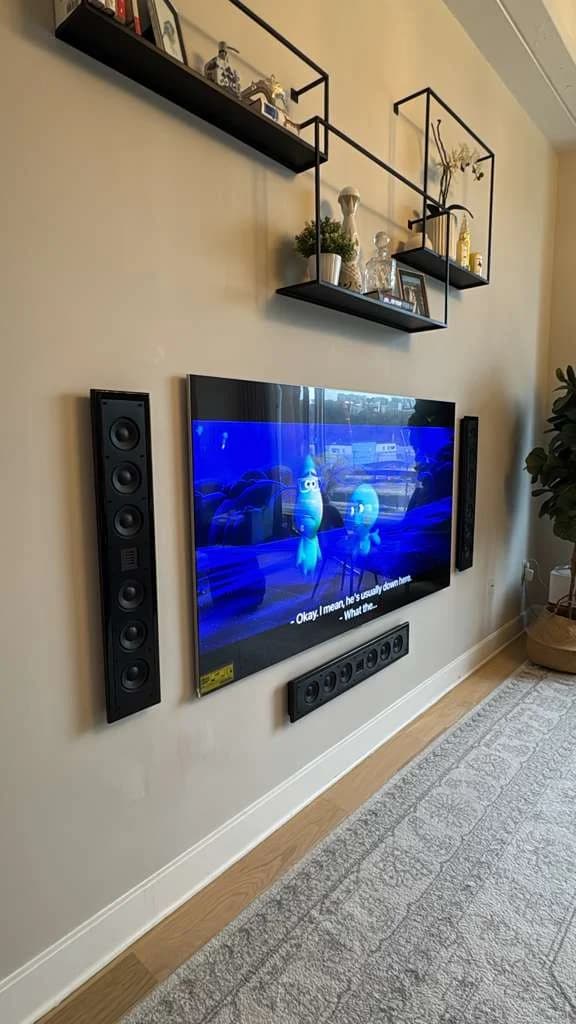
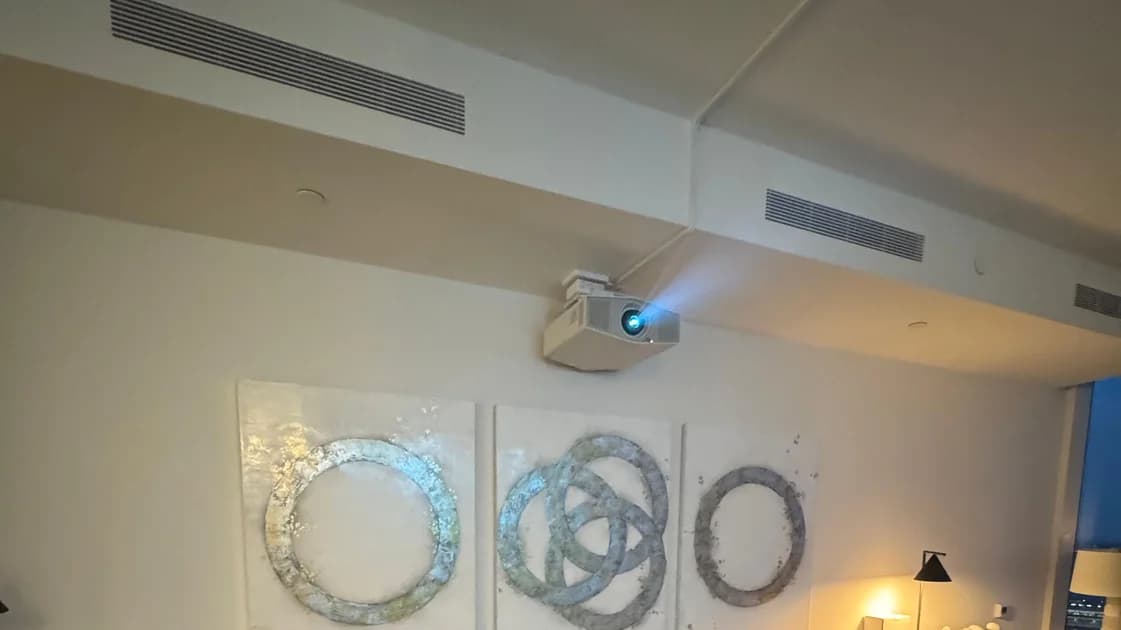

Owners on Reddit say an OLED has the better picture, but a projector's huge image is the one that makes them smile. Read what owners say ↓
What owners on Reddit say
"The image on the OLED is better in every conceivable metric but the projector image still puts a huge smile on my face." — one owner, r/hometheater (thread)
"I just picked up a projector and now I want to save every movie for it. It's the best." — one owner, r/hometheater (thread)
"If your top priority is the crispest picture quality with deep, inky blacks, OLED is unbeatable." — one owner, r/hometheater (thread)
Projector owners talk about the feeling. TV owners talk about the picture. Your room decides which one matters more.
Who's this for? Anyone choosing between a projector and a large TV for a home theater setup in a NYC apartment or house.
This guide walks through the key differences — screen size, light control, room depth, and install complexity — so you can make the right call for your specific space.
On this page
How a TV wins
The biggest advantage is brightness. A good TV pushes out enough light to look vivid in a sunlit living room, during a 1 PM football game, or with the overhead lights on. You don't have to redesign your space around it or wait for nightfall to enjoy it. That matters a lot in a city apartment where the TV often lives in the same room you cook, work, and entertain in.
TVs also win on simplicity and reliability. There's one box, it turns on instantly, the speakers are built in, and there are no consumables to replace. A panel that's properly mounted to the wall disappears into the room and frees up floor space — which is gold in a small apartment.
Picture quality at normal viewing distances is superb. Deep blacks, fine detail, and high contrast all come standard now. Our team keeps a current rundown in our guide to the best TVs of 2026.
How a projector wins
A projector wins on the one thing a TV physically can't match: scale. A 100-, 120-, or even 150-inch image wraps around your field of view in a way that no living-room TV does. For movie nights, sports parties, and gaming, that immersion is the whole point — it's the closest you'll get to a real cinema at home.
Big images on a projection screen are often easier on the eyes too. Light is reflected off a screen rather than emitted straight at you. Many people find this more comfortable for long viewing sessions.
Dollar-for-diagonal-inch, projectors are efficient — once you're talking about an image bigger than the largest consumer TVs. But it comes with a catch: throw distance and light control. For a deeper look at projector picture quality, see our guide to the best home theater projector.
Throw distance and room size
Throw distance is how far the projector sits from the screen to fill it. Traditional projectors need 10 to 14 feet for a 100-inch image. In a sprawling suburban basement, no problem. In a 12-foot-wide NYC living room, that's a tight squeeze.
Ultra-short-throw (UST) projectors change the math entirely. A UST unit sits on a console just inches from the wall and throws a huge image upward — no ceiling mount, no cable run across the room, no shadow when someone walks past. For apartments, UST is often the difference between "a projector is impossible here" and "this actually works."
Ceiling height matters too. A standard 8-to-9-foot apartment ceiling is fine for most setups — but it limits how high you can mount a screen and still keep comfortable sightlines from the couch.
Light control: the deciding factor
If you remember one thing from this post, make it this: a projector is only as good as your ability to control light.
Projected images are reflected, not emitted. Ambient light from a window or lamp washes them out — colors fade, blacks turn gray, and the picture loses its pop. A dedicated dark room makes a mid-range projector look spectacular. A bright room with two big windows can make even an expensive projector look disappointing.
You have a few levers:
- Blackout shades or heavy curtains to kill daylight.
- Ambient-light-rejecting (ALR) screens, engineered to reject overhead and side light and reflect only the projector's beam. Paired with a UST projector, an ALR screen can hold up surprisingly well in a room that isn't pitch black.
- Lighting design — lamps on dimmers, kept off to the sides rather than facing the screen.
A TV, by contrast, simply doesn't care. It's bright enough to win against the windows. If your "theater" doubles as your everyday living room and you can't or won't black it out, that's a strong vote for a TV.
TV vs projector: side-by-side comparison
| Factor | TV | Projector |
|---|---|---|
| Typical screen size | 55"–98" | 100"–150"+ |
| Brightness / bright-room use | Excellent — looks great with lights and windows | Needs darkness or an ALR screen; long-throw struggles in bright rooms |
| Light control needed | Minimal | High (or UST + ALR screen) |
| Immersion / "cinema" feel | Good | Best-in-class at large sizes |
| Cost tier | Entry to premium, broad range | Mid (long-throw) to premium (quality UST + screen) |
| Install complexity | Low — wall mount and tidy cables | Higher — screen, projector placement, cable runs, calibration |
| Apartment fit | Excellent — compact, no room redesign | Good with UST; harder with long-throw in tight rooms |
| Daily / casual use | Ideal — instant on, set-and-forget | Better suited to deliberate movie or game nights |
The NYC apartment reality
New York rooms come with their own rulebook, and it tilts the decision in real ways.
Windows and light. City apartments are often valued for their light — which is wonderful for living and tough for projection. Big, undressed windows are a TV's best friend and a long-throw projector's worst enemy. If you love your natural light and don't want blackout shades, lean TV. If you have a den or a room you're happy to darken, a projector becomes viable.
Throw distance. Many NYC living rooms simply aren't deep enough for a long-throw projector to fill a big screen without mounting it awkwardly far back. This is exactly the scenario UST projectors were built for — a slim console under the screen, no ceiling rig, no tripping over a cable.
Ceilings and walls. Older buildings bring plaster walls, brick, and uneven ceilings that complicate both ceiling mounts and in-wall cable runs. Co-op and condo rules can also limit what you're allowed to drill or route. None of this is a dealbreaker — it just means the install needs to be planned by someone who works in these buildings every day.
Square footage. When floor space is precious, a wall-mounted TV or a UST-plus-console projector both keep your footprint small. A traditional setup with a ceiling projector and a fixed front screen asks more of the room.
Install and mounting considerations
A TV install is straightforward: a secure wall mount rated for the panel, cables concealed in or along the wall, and components tucked neatly nearby. You'll see the estimated total before you submit your booking request.
A projector setup has more moving parts. A long-throw projector needs a level, vibration-free ceiling mount and a clean cable run back to your sources — through the ceiling or wall where the building allows. The screen has to be positioned at the right height and centered to the seating. A UST projector skips the ceiling mount but demands precise placement on its console; even a fraction of an inch off and the image goes crooked at the corners.
Sound and calibration make or break the experience. A big picture with thin built-in speakers is a letdown. A proper room pairs the display with a real surround system. The gold standard is object-based audio that places sound above and around you. Read our breakdown of a Dolby Atmos home theater to see why that matters. And for a fully custom build, our walkthrough of how a custom home theater project works shows what a complete, integrated room looks like.
Budget tiers
Think in tiers rather than exact dollars — your final number depends on the room, the gear, and how integrated you want everything.
Entry — TV-first. A quality large TV, a solid wall mount, concealed cables, and a good soundbar or compact surround system. This is the most common, most flexible choice for an everyday NYC living room.
Mid — projector or premium TV. A long-throw or short-throw projector with a quality screen, plus surround sound and proper cable management. Budget for light control (shades or an ALR screen) as part of the package, not an afterthought.
Premium — dedicated home theater. A UST or high-end projector with an ALR screen (or a flagship big-screen TV), full surround with in-ceiling height channels, acoustic treatment, smart-home control, and professional calibration. Our home theater installation service is a quote-based design-and-build offering starting from $10,000, scaled to your space and goals.
Not sure which tier fits? Our setup finder walks you through it, and our recommendations hub has vetted picks for screens, sound, and mounts.
Your 6-point decision checklist
Run through these and the answer usually becomes obvious:
- Can you control the light? Yes (dedicated/darkenable room) leans projector. No (bright, window-heavy living room) leans TV.
- How deep is the room? Plenty of depth opens up long-throw projectors; tight rooms point to UST or a TV.
- How big do you want to go? Above the largest TVs (100"+) means a projector. A 65"–85" panel covers most living rooms beautifully.
- Daily use or movie nights? Everyday casual viewing favors a TV's instant-on simplicity. Deliberate cinema nights favor a projector.
- What's your building like? Plaster, brick, co-op drilling rules, and ceiling height all affect what's practical — get it assessed before you buy.
- What's the budget, end to end? Include the screen, sound, light control, and install — not just the display — so you compare apples to apples.
Still torn? That's normal — the right answer is specific to your room. Call us at (646) 912-5050 or book a consultation and we'll look at your space, your light, and your wish list, then recommend the setup that'll actually make you happy.
Frequently Asked Questions
Is a projector or TV better for a small NYC apartment?
For most small apartments, a TV is the easier, more forgiving choice — it stays bright against big city windows, mounts flat to the wall, and needs no room redesign. A projector can absolutely work in an apartment, but usually only with an ultra-short-throw model and either blackout shades or an ambient-light-rejecting screen. If you have a room you can darken and you want a 100-inch-plus image, the projector becomes worth it.
Do I really need a dark room for a projector?
You need light control, which isn't always the same as total darkness. A long-throw projector wants a genuinely dark room to look its best. A modern ultra-short-throw projector paired with an ambient-light-rejecting screen can hold up well in a room with some controlled ambient light. But a bright, sun-filled space with no shades will wash out almost any projector — that's the scenario where a TV simply wins.
How big a screen can I get with a projector versus a TV?
Consumer TVs top out around 98 inches, and the largest ones are very expensive. Projectors comfortably reach 100, 120, even 150 inches and beyond, and they get more cost-effective per inch the bigger you go — provided your room has the throw distance (or you use an ultra-short-throw model) and the light control to support it.
Which is more expensive overall?
It depends on where you land. A quality large TV with a mount and soundbar can be the most affordable complete setup. A mid-range projector plus a good screen and surround sound sits higher, and a dedicated, fully integrated theater is the premium tier. The key is to budget for the whole room — display, screen, sound, light control, and professional install — rather than just the headline price of the projector or panel.
Can you mount a projector and screen in a co-op or older building?
Yes, and it's something we do regularly. Older NYC buildings bring plaster walls, brick, and co-op or condo rules that affect drilling and cable routing, so the install gets planned around those realities. Ultra-short-throw projectors are often ideal here because they skip the ceiling mount and long cable runs entirely. We assess your walls, ceiling, and building rules before recommending an approach.
What about sound — is the built-in audio enough?
No. A big, beautiful image with thin built-in speakers always disappoints. Whether you choose a TV or a projector, plan for a real surround system. The best experiences use object-based audio with in-ceiling height channels so sound comes from above and around you, and they include professional calibration so everything is balanced for your specific room.
Ready to figure out the right big-screen setup for your space? Explore our home theater installation service, browse our gear recommendations, or call (646) 912-5050. When you're ready, book your consultation — we'll spec it to your room, your light, and your budget.