For a dedicated home theater, Sony and JVC are the gold standard. Both are laser 4K, built to last decades, and the only projectors we install for custom builds.
Who's this for? Anyone building a projector-based home theater — whether you want a professional design-and-install or a DIY setup — and needs to know what actually matters before spending thousands.
This guide covers what specs to care about, our professional picks with prices, budget alternatives, UST (ultra-short-throw) options for tight NYC apartments, and screen pairings.
The short answer
- Our top picks: Sony and JVC laser 4K projectors — reference-grade, for dedicated dark rooms, starting from ~$6K.
- NYC apartments: ultra-short-throw (UST) projectors sit inches from the wall. No ceiling mount, no 12-foot throw distance needed.
- The spec that matters most: contrast ratio (how black the blacks look), not just resolution.
- Don't forget the screen — a dedicated screen makes a bigger difference than most people expect.
- Budget-friendly? Plenty of solid options under $2,000 for DIY builds.
- Ready to build a custom setup? Book a consultation and we'll design it around your space.
What actually matters when choosing a projector
Before specific models — the specs that make a real-world difference.
Throw distance is how far the projector sits from the screen to fill it. Standard throw needs 10–15 feet for a 100" image. Short-throw needs 4–6 feet. Ultra-short-throw (UST) sits inches from the wall. If your room is under 12 feet deep, check throw distance first.
Resolution — native 4K (3840×2160) is the gold standard. Pixel-shifted 4K uses a 1080p chip that rapidly shifts pixels to simulate 4K. For screens over 100", native 4K matters. Under 100", the difference is hard to see at normal viewing distance.
Brightness — for a dark, light-controlled room, 1,500–2,000 lumens is plenty. For a room with ambient light, 2,500+ lumens. UST projectors with ALR (ambient light rejecting) screens can handle brighter rooms at lower lumen counts.
Contrast ratio is how deep the blacks look. Laser projectors have better contrast than lamp-based. A high contrast ratio makes a bigger visual difference than raw resolution in most setups.
Light source — laser projectors last 20,000–30,000 hours with no bulb replacement. Lamp-based projectors need a new bulb ($300–$400 for OEM) every 3,000–5,000 hours on standard mode.
Our picks: Sony and JVC (what we install)
These are the projectors we recommend and install for custom home theater builds. All are laser 4K with reference-grade image quality.
Sony
| Model | Price | Key Feature |
|---|
| VPL-XW5000ES | ~$6,000 | Entry to Sony's laser 4K lineup. Native 4K SXRD panels, wide lens shift, whisper-quiet. The sharpest image in this price range. |
| BRAVIA Projector 8 | ~$19,000 | Flagship processing, exceptional upscaling of lower-res content. For clients who prioritize picture quality above all else. |
| BRAVIA Projector 9 | ~$32,000 | The best home theater projector available. Reference-grade for serious theater rooms. |
Sony's SXRD technology (their proprietary reflective LCD) delivers true native 4K — not pixel-shifted. The difference is visible on screens 100" and larger. Sony's processing also makes lower-resolution content look remarkably good.
Best for: Dedicated theater rooms with light control. Clients building custom home theaters.
Want us to design a projector setup for your space? Explore our custom AV and home theatre services — we handle projector, screen, sound, and cable management as one integrated build.
JVC
| Model | Price | Key Feature |
|---|
| DLA-NZ7 | ~$11,000 | Best-in-class contrast ratio. Native 4K D-ILA. Blacks that are genuinely black. |
| DLA-NZ800 | ~$16,000 | HDR performance leader with BLU-Escent laser engine. Exceptional dynamic range. |
| DLA-NZ900 | ~$30,000 | The deepest blacks in any home projector. If contrast and black levels are your priority, this is it. |
JVC's D-ILA technology produces the best contrast ratios in the industry. In a properly dark room, a JVC projector makes blacks look truly black — not the dark gray most projectors produce. The difference is striking.
Best for: Cinephiles who care about contrast and black levels. Rooms that can be fully darkened.
Check our equipment recommendations for projector mounts, cables, and accessories.
Sony vs. JVC — how to choose
| Priority | Choose |
|---|
| Sharpest 4K image, best processing | Sony |
| Deepest blacks, best contrast | JVC |
| Bright room or some ambient light | Sony (slightly higher brightness) |
| Completely dark room | JVC (contrast advantage shines in the dark) |
Budget alternatives (DIY-friendly)
If you're building a setup yourself or want something more affordable, these deliver genuinely good results.
Under $2,000
Epson Home Cinema 2350 (~$1,300) — Our most-recommended budget projector. 3LCD (no rainbow effect), 2,800 lumens, pixel-shifted 4K. Built-in Android TV. Bright enough for rooms with some ambient light.
XGIMI Horizon Ultra (~$1,700) — Compact, Dolby Vision support (rare at this price), auto-focus and keystone correction. Great for renters who move the projector between rooms.
$1,500–$2,000
Epson Home Cinema 3200 (~$1,500) — 3LCD, powered lens shift for easy ceiling mounting. We ceiling-mount a lot of these in dedicated media rooms.
BenQ TK860i (~$1,700) — 3,300 lumens, true 4K via pixel shift, HDR10+. One of the brightest projectors in its range. Excellent for sports and rooms that can't be fully darkened.
$3,000+
Hisense PX3-PRO (~$3,500) — UST, Dolby Vision, triple laser, native 4K. Best value in the premium UST category. See the UST section below.
UST projectors: the NYC apartment solution
Most NYC living rooms are 10–14 feet wide. After furniture, you have 8–10 feet of space — sometimes less. A standard projector 10 feet from the wall isn't practical in most apartments.
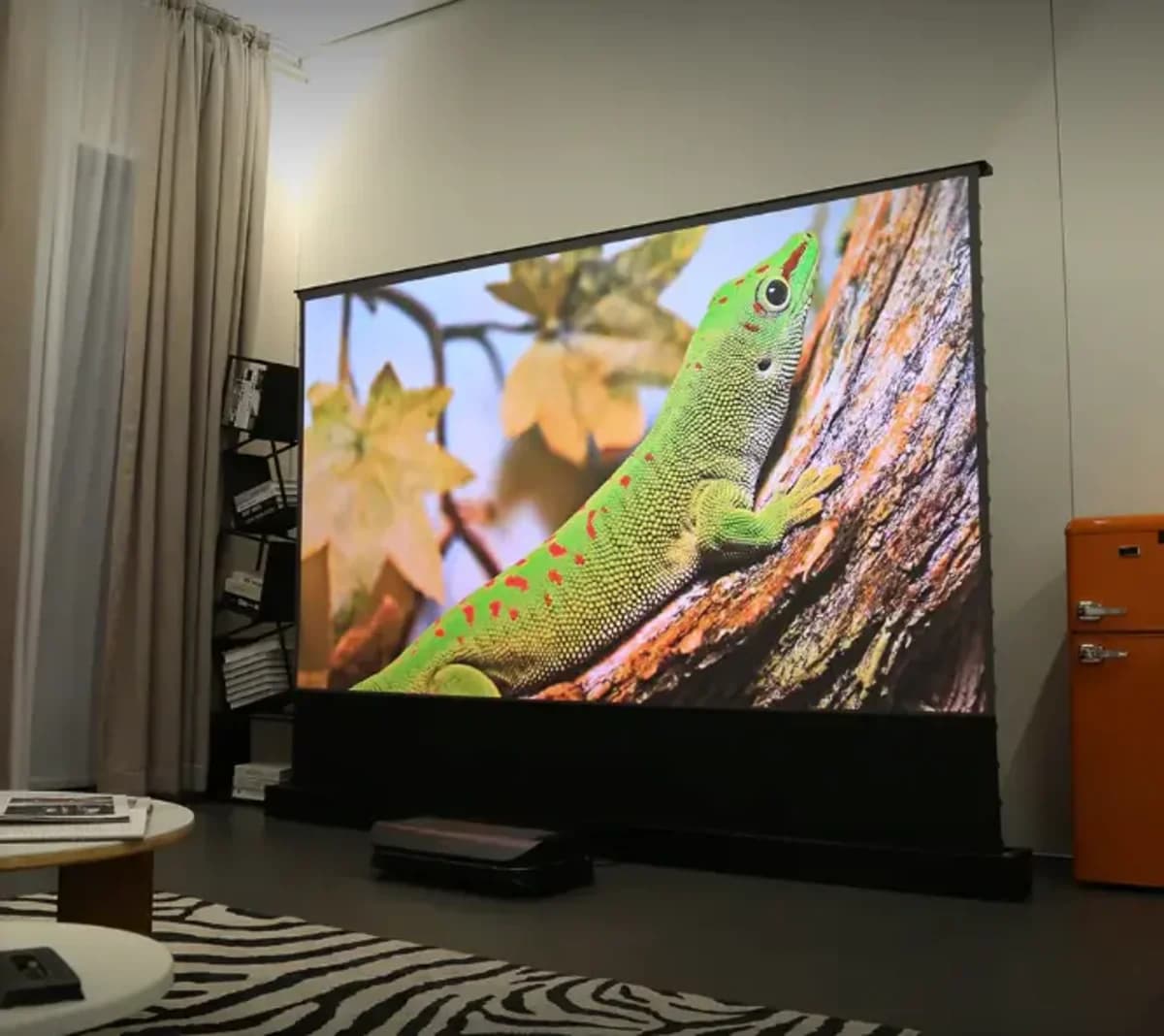
UST (ultra-short-throw) projectors sit on a media console inches from the wall and produce a 100–120" image. No ceiling mount, no long throw distance needed.
Our top UST pick
| Model | Price | Brightness | HDR | Notes |
|---|
| Hisense PX3-PRO | ~$3,500 | 3,000 lumens | Dolby Vision, HDR10+ | Best value UST. Triple laser, Dolby Vision at this price point is unmatched. |
UST setup considerations
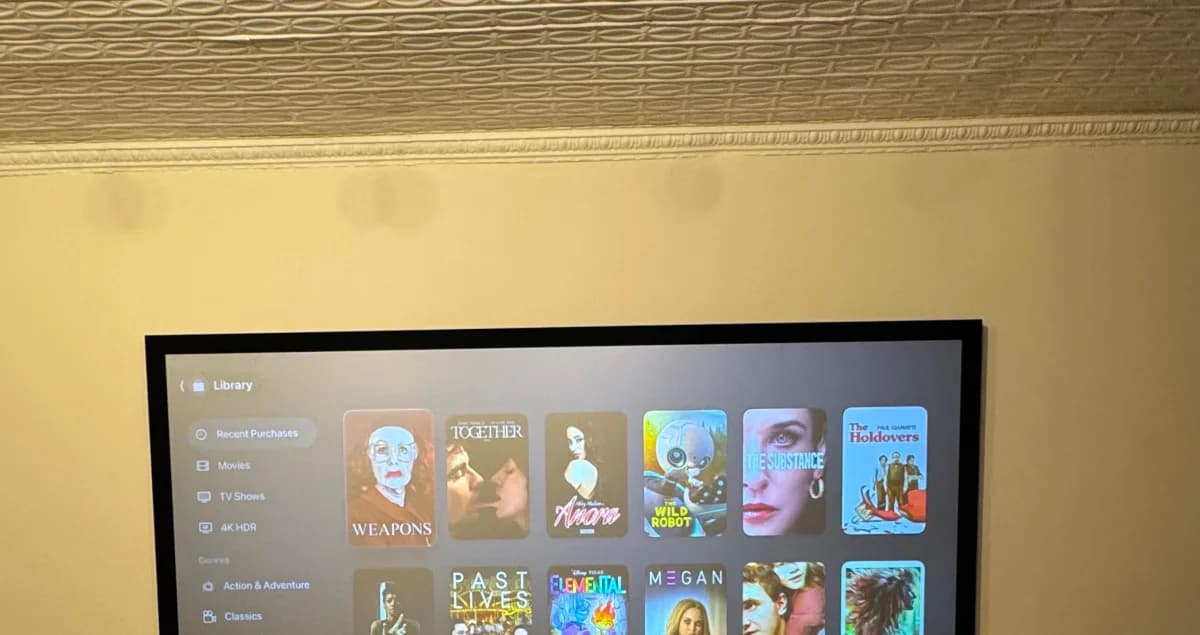
The screen matters more with UST. The steep projection angle means ambient light hits the screen differently. An ALR (ambient light rejecting) screen is strongly recommended — $500–$1,500 for 100". A plain white wall will look washed out.
The surface must be perfectly flat. UST projectors are extremely sensitive to surface irregularities. Rigid ALR screens solve this — avoid pull-down screens with UST projectors.
Placement is critical. The projector must be perfectly centered and level. Even a quarter-inch off-center shows up as distortion on a 100" screen. We use laser-leveling tools for UST placement.
Heat ventilation. UST projectors sit in furniture, not on an open ceiling. Make sure there's 6+ inches of clearance above and behind for airflow.
Screen recommendations
A projector is only as good as its screen.
| Setup | Screen Type | Budget | Pick |
|---|
| Dark room, standard throw | White matte, fixed frame | $300–$500 | Silver Ticket STR-169100 (100") |
| Dark room, premium | Gray, fixed frame | $500–$800 | Elite Screens Aeon CineGrey 3D |
| Ambient light room | High-gain, fixed frame | $600–$1,000 | Stewart Cima Neve |
| UST projector | ALR, fixed frame | $800–$1,500 | Hisense ALR or Vividstorm S Pro |
| Temporary / rental | Pull-down, motorized | $200–$400 | Elite Screens Spectrum |
Fixed-frame screens look the best and cost less than motorized. If you're investing in a projector, invest in a proper screen. The difference between a dedicated screen and a white wall is dramatic.
Sound: don't forget the other half
Every projector has built-in speakers. Every projector's built-in speakers are inadequate. Budget for audio separately.
| Level | Setup | Budget |
|---|
| Minimum | Soundbar (Sonos Beam, Samsung HW-Q800D) | $400–$700 |
| Better | Soundbar + wireless subwoofer | $600–$1,200 |
| Best | 5.1 or 7.1 surround with AV receiver | $1,500–$5,000+ |
| Reference | 7.1.4 Dolby Atmos with in-ceiling speakers | $5,500–$11,000+ |
For our custom home theater builds, we design the projector, screen, and surround sound as one integrated system — read our full guide on Dolby Atmos setups.
Need the full package? Our custom AV and home theatre service includes projector mounting, screen installation, surround sound, and cable management — designed and installed as one build. Request a consultation to get started.
Home theater ideas with projectors
The brownstone basement theater
Brooklyn and Harlem brownstones often have basement spaces perfect for dedicated theaters — low natural light, solid walls, enough square footage for 120–150" screens. Pair a Sony VPL-XW5000ES with a fixed-frame screen, 7.1.4 Atmos, acoustic treatment, and theater seating for the full experience.
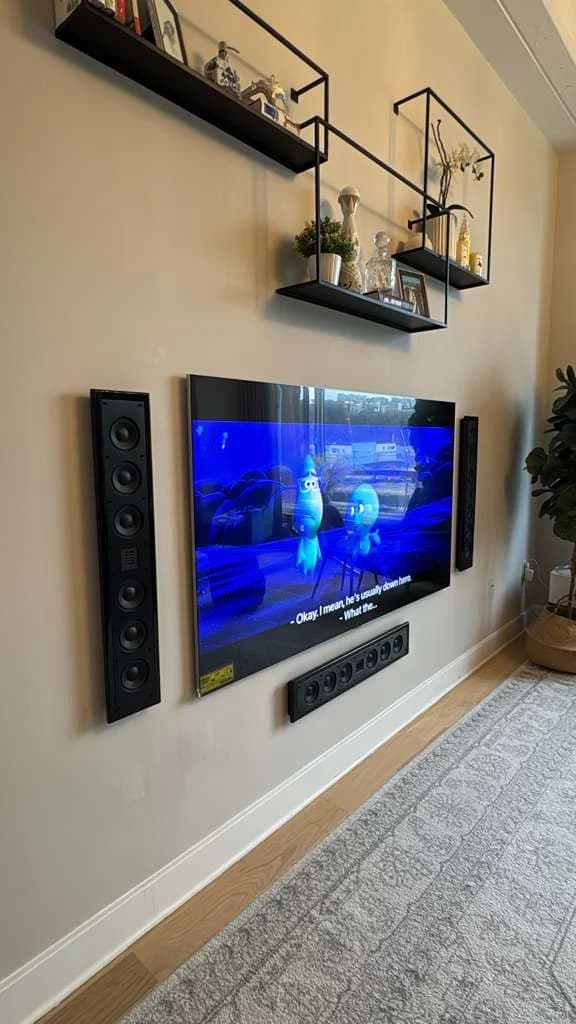
A UST projector on a custom media console with a 100" ALR screen, in-wall speakers, and motorized solar shades for daytime viewing. The projector replaces a TV entirely — bigger screen, cleaner look.
The living room cinema
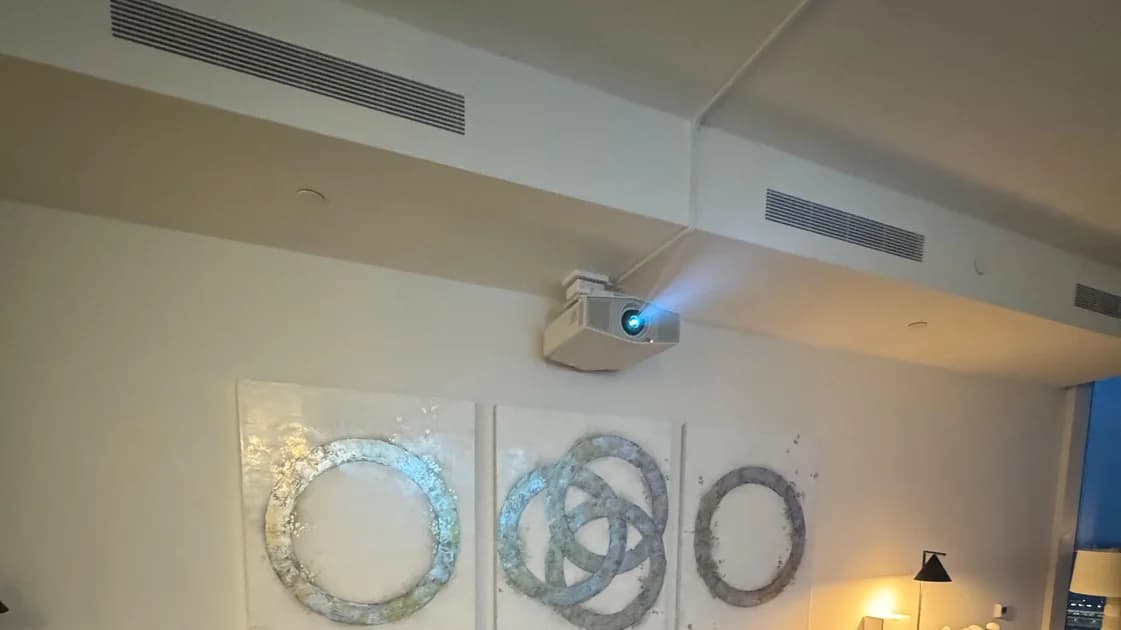
A short-throw or UST projector with a motorized screen that retracts into the ceiling when not in use. During the day, it's a normal living room. Movie night, the screen drops and the lights dim — all controlled from a single remote via a home automation system like Control4 (one remote for projector, screen, lights, and sound).
The multipurpose room
An 85–97" OLED or LED wall for everyday viewing, paired with a separate projector and motorized screen for movie nights. Two display modes in one room.
Frequently Asked Questions
Is a projector better than a 75" or 85" TV?
They serve different purposes. A projector gives you 100–150" for $1,000–$6,000. A TV that size costs $5,000–$15,000+. But projectors need a darker room. For a dedicated theater room, a projector wins. For an everyday living room with open blinds, a TV is more practical.
Can I use a projector in a bright NYC apartment?
Yes, with the right setup. A high-brightness projector (2,500+ lumens) with an ALR screen handles ambient light well. Blackout curtains help dramatically. UST projectors with ALR screens handle bright rooms better than standard-throw projectors because the screen rejects overhead light.
How long do projector light sources last?
Laser projectors: 20,000–30,000 hours — effectively the lifetime of the projector. At 4 hours/day, that's 14–20 years. Lamp-based: 3,000–5,000 hours standard, up to 15,000 in eco mode. OEM replacement lamps cost $300–$400.
What size screen for a NYC living room?
Measure your wall and viewing distance. Standard recommendation: screen should be about 40% of your viewing distance. Sitting 10 feet away = 100" screen. For most NYC apartments, 80–100" is the sweet spot.
Do I need a ceiling mount?
Not for UST projectors — they sit on a console. For standard-throw projectors, ceiling mounts give the cleanest look and free up furniture. Tabletop placement works too with keystone correction.
Ready to set up your projector theater?
The projector you choose matters — but the installation determines whether you end up with a "cool projector" or an actual home theater. Screen placement, throw distance, ambient light, sound design, and cable management all need to work together.
For custom builds — projector, screen, surround sound, acoustic treatment, and control system — we handle everything from design through calibration.
Our home theater services
| Service | What's Included |
|---|
| Custom AV & Home Theatre | Full projector + screen + sound design, built and installed as one integrated system |
| TV Mounting | If you're ceiling-mounting a projector, we handle that too — starting at $175 |
| Soundbar Mounting | Soundbar installation for simpler audio setups — $69 |
Need help choosing? Check our equipment recommendations for projector mounts, screens, and cables. Or request a consultation and we'll design the setup around your room.
We serve Manhattan, Brooklyn, Queens, the Bronx, Staten Island, and parts of New Jersey. Book your installation or request a quote.