The right speaker depends on your room, your walls, and whether you rent or own. There's no one-size-fits-all — but a few simple questions make the choice obvious.
Who's this for? Anyone building or upgrading a home theater speaker system — especially in a NYC apartment where wall type and floor space create real constraints.
This guide covers the five main speaker types, what each one does, how to match them to your room, and the NYC realities (plaster, NYCHA, brick) that most guides skip.
The short answer
- 5 speaker types: floorstanding, bookshelf, in-wall, in-ceiling, and satellite — each trades sound quality against size and install effort.
- NYC wall type is the deciding factor for in-wall/in-ceiling speakers. Drywall = yes. Plaster, brick, concrete = usually no.
- Renters: stick with bookshelf, floorstanding, or satellite. They move with you.
- Owners: in-wall and in-ceiling speakers give you a clean, invisible look that's built into the room.
- Don't skip the center channel — it carries about two-thirds of all dialogue.
- Want it designed and installed properly? Our home theater installation service handles layout, mounting, and calibration end to end. Book a consultation or call (646) 912-5050.
What each speaker actually does
A home theater system isn't one speaker doing everything — it's a team, and each member has a job. Understanding the roles makes the rest of your decisions much easier.
Front left and right
These carry most of the music, sound effects, and the overall "size" of the soundstage. They sit on either side of your TV or screen. If you only upgraded one pair of speakers, this is the pair.
Center channel
The center sits directly above or below the screen and handles dialogue. Roughly two-thirds of a movie's sound comes through the center. A good center channel is the difference between "I can hear them clearly" and "let me turn on subtitles."
Surrounds
Placed to the sides or slightly behind your seating, surrounds create the sense of being inside the scene — rain behind you, a car passing, the ambient hum of a room. In a 5.1 system there are two surrounds; in a 7.1 system there are four.
Height / Atmos speakers
These add the vertical dimension — sound from above. A helicopter overhead, rain on a roof, thunder rolling across the ceiling. They're either in-ceiling speakers or up-firing modules that bounce sound off the ceiling. If you want the full immersive effect, our guide to building a Dolby Atmos home theater breaks down exactly how height channels work.
Subwoofer
The subwoofer handles the low end — explosions, engine rumble, the bass in a soundtrack. It's the difference between hearing an impact and feeling it. Subwoofers are placed on the floor and don't need to match the other speakers visually, which gives you flexibility on placement.
The five speaker types compared
| Speaker Type | Sound Quality | Aesthetics | Install Effort | Flexibility | Apartment Fit |
|---|---|---|---|---|---|
| Floorstanding | Excellent, full-range | Large, visible footprint | Low (just place them) | High — move anytime | Fair — needs floor space |
| Bookshelf | Very good | Compact, sit on stands/shelves | Low to moderate | High — easy to reposition | Good — fits tight rooms |
| In-Wall | Very good | Nearly invisible, flush | High — cuts into wall | Low — permanent | Good if drywall, not plaster |
| In-Ceiling | Good (great for height) | Invisible overhead | High — cuts into ceiling | Low — permanent | Best option for Atmos |
| Satellite | Modest, needs a sub | Tiny, discreet | Low | High — very portable | Excellent — minimal space |
Floorstanding speakers deliver the biggest, fullest sound. They often don't even need a subwoofer for the front channels. But they take up real floor space — precious in a NYC apartment.
Bookshelf speakers are the sweet spot for many city rooms. Nearly the performance of floorstanders in a fraction of the footprint. Easy to set on stands, shelves, or a media console.
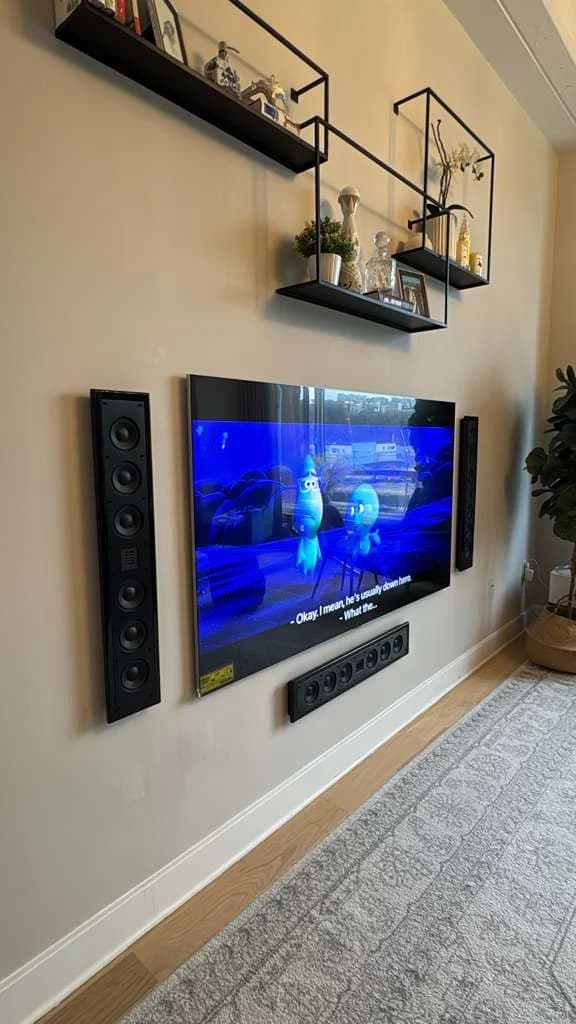
In-wall and in-ceiling speakers disappear into the room entirely — the go-to for design-forward installs where nothing should clutter the space. The catch: they require cutting into the wall or ceiling and running cable behind it. More on that below.
Satellite speakers are the smallest option, usually paired with a dedicated subwoofer. Ideal when space is at an absolute premium.
Matching speakers to your room size
Bigger speakers in a small room can overwhelm it. Small speakers in a large room sound thin. Match the speaker to the space.
- Small rooms / studios (under ~150 sq ft): Bookshelf or satellite speakers with a compact subwoofer. Floorstanders are usually overkill and eat space you don't have.
- Medium rooms (~150–300 sq ft): Bookshelf speakers for the front pair, in-wall or on-wall surrounds, and a single subwoofer. The most common NYC apartment scenario.
- Large rooms / dedicated theaters (300+ sq ft): Floorstanding or larger in-wall front speakers, multiple surrounds, in-ceiling height channels, and possibly dual subwoofers for even bass coverage.
If you're not sure what your room can support, our setup finder walks you through a few questions and points you toward gear that fits.
Speaker placement basics
Even great speakers sound mediocre in the wrong spots. A few fundamentals:
- Front left/right — roughly ear-level when seated, angled slightly toward the main seat, spaced so they form a triangle with your listening position.
- Center channel — as close to the screen as possible, aimed at ear level so dialogue lands clearly.
- Surrounds — to the sides or slightly behind the seating, ideally a foot or two above ear level.
- Height/Atmos — in the ceiling, slightly in front of and behind the main seat; or use up-firing modules placed on top of your front speakers.
- Subwoofer — placement is flexible, but corners boost bass. Experiment to avoid a "boomy" or "dead" spot.
Placement is also where renters hit limits — you can't always put a speaker exactly where the math wants it. Good calibration can compensate for a lot. A soundbar-based setup is a legitimate middle ground if a full surround layout isn't realistic. See how we mount soundbars if that's the direction you're leaning.
In-wall and in-ceiling: the install reality
This is the part that trips up a lot of NYC homeowners, so it's worth being clear.
In-wall and in-ceiling speakers require two things: a cavity to drop the speaker into, and a path to run speaker cable behind the surface. That's straightforward in standard drywall — the kind in most modern construction and renovated apartments. We can cut a clean opening, fish the wire through the cavity, and mount the speaker flush.
It gets harder — or impossible — with other wall types:
- Prewar plaster (common in older NYC buildings) is thick, brittle, and often backed by wood lath. Cutting into it cleanly is tricky, the cavity may be obstructed, and the work is far more involved. In-wall installs here are case-by-case and sometimes not advisable.
- Brick and concrete can't take in-wall speakers at all — there's no cavity and nothing to route cable through. These rooms need on-wall or surface-mounted speakers with the cable run in a paintable raceway instead.
- NYCHA walls are typically only about half an inch thick and rated for light loads. They won't support in-wall speakers — surface-mounted, lightweight options with appropriate anchors are the right call.
The honest version: if your apartment is drywall, in-wall and in-ceiling speakers are a clean, premium look. If it's plaster, brick, or concrete, on-wall and bookshelf speakers will give you the same sound without fighting the building. We'll tell you which camp you're in before any cutting happens. Our full home theater installation service starts from $10,000 and covers design, in-wall and in-ceiling work where the walls allow, cable routing, and professional calibration.
Renter vs. owner: different choices
Your living situation should steer your speaker type as much as your budget does.
If you rent, lean toward speakers that don't require cutting into walls or ceilings: floorstanding, bookshelf, or satellite speakers, paired with on-wall surrounds where needed. Cable can run discreetly along baseboards or in removable raceways. When you move, the whole system comes with you.
If you own, in-wall and in-ceiling speakers become much more attractive — you can commit to a permanent, invisible install that's built into the room. This is where a clean, designed-in system really shines, and it's the foundation of most of our custom home theater installations.
Either way, mounting the TV cleanly is part of the same job — our TV mounting service and soundbar mounting service tie the picture and sound together on the same wall.
When to hire a pro
Plenty of speaker work is DIY-friendly — placing bookshelf speakers, hooking up a subwoofer, plugging in a soundbar. Bring in a professional when:
- You want in-wall or in-ceiling speakers and need someone who can read your wall type and cut cleanly.
- You're running cable inside the wall — this is drywall-only work, and getting it right (and to code) matters.
- You're building a full surround or Atmos system and want it calibrated, not just installed.
- Your building is prewar, brick, or NYCHA and you're not sure what's even possible.
A pro saves you from a wall full of holes in the wrong places and a system that never sounds the way it should. Browse our gear recommendations if you want to start shopping, or book a consultation and we'll design the layout around your actual room.
Your speaker selection checklist
Before you buy, run through these:
- Measure your room — square footage and ceiling height decide whether floorstanding speakers make sense or whether bookshelf/satellite is smarter.
- Identify your wall type — drywall opens up in-wall/in-ceiling options; plaster, brick, and concrete steer you to on-wall and bookshelf.
- Pick your channel count — 5.1 is the baseline, 7.1 adds rear surrounds, and adding height channels gets you to Atmos.
- Prioritize the center channel — dialogue clarity matters more day to day than almost anything else.
- Plan placement before purchase — confirm your seating and walls can actually accommodate the layout.
- Decide rent vs. own — let it dictate permanent (in-wall) vs. movable (floorstanding/bookshelf) speakers.
- Get a pro opinion on tricky walls — when in doubt, ask before you cut.
Frequently Asked Questions
Are in-wall speakers worth it in an apartment?
It depends entirely on your walls. In a drywall apartment, in-wall speakers are a clean, premium choice — they disappear into the room and free up floor space. But in prewar plaster, brick, or concrete units, in-wall installs are difficult or impossible. On-wall or bookshelf speakers will give you the same sound quality without fighting the building. If you rent, also weigh the fact that in-wall work is permanent and stays behind when you move.
What's the difference between in-wall and in-ceiling speakers?
In-wall speakers handle the main channels — front left/right, center, and surrounds — mounted flush in your walls at ear level. In-ceiling speakers are mounted overhead and are mainly used for height/Atmos channels, delivering sound from above. Many immersive setups use both: in-wall for the horizontal soundstage and in-ceiling for the vertical, overhead effects.
Do I really need a center channel speaker?
For a true home theater, yes. The center channel carries the majority of dialogue. Without it, voices get spread across your left and right speakers, which can make them sound vague or off-center. If you're using a soundbar instead of separate speakers, the bar includes a built-in center channel — so you're covered there.
Can I add Atmos height speakers later?
Often, yes. If your system uses an Atmos-capable receiver, you can add in-ceiling or up-firing height speakers down the line. The smart move is to plan for it during the initial install — running ceiling cable while the work is already open is far easier than going back later. We can future-proof the wiring even if you start with a simpler 5.1 setup.
Will speakers work with my prewar NYC walls?
Free-standing speakers like floorstanding, bookshelf, and satellite work in any apartment regardless of wall type. The constraint is only on in-wall and in-ceiling speakers, which need a drywall cavity and a clear cable path. Prewar plaster is case-by-case, and brick or concrete generally rules out in-wall entirely — but on-wall and surface-mounted options sound just as good. Call us at (646) 912-5050 and we'll assess your specific walls before recommending anything.
How much does a full home theater speaker system cost?
It varies widely based on speaker type, channel count, and how much in-wall or in-ceiling work your room needs. Our complete home theater installation service starts from $10,000 and is quote-based — covering system design, speaker and equipment selection, mounting, cable routing where the walls allow, and professional calibration. For a tailored estimate, book a consultation or call (646) 912-5050.