
Who's this for? Business owners, office managers, and property managers in NYC who need displays installed in an office, restaurant, lobby, gym, or retail space.
This guide covers what commercial TV installation actually includes, which industries we serve, why commercial work is different from a home install, and how the process works from first call to finished room.
When a business in New York City needs a TV or display installed, the job is rarely as simple as it sounds. A single screen in a waiting room might be straightforward. But most commercial work involves heavier hardware, tougher walls, tighter scheduling windows, and a building that has rules about who works in it and when. That's the gap between a quick home install and a proper commercial job — and it's the work we do every day across Manhattan and the outer boroughs.
On this page
What Commercial TV Installation Covers
"Commercial TV installation" is an umbrella term. In practice it breaks into a handful of distinct project types — and most businesses end up needing more than one.
Single and Multi-Display Installs
The most common request is a single display mounted cleanly on a wall — a screen behind a reception desk, a TV in a break room, a monitor in a waiting area. Even these "simple" jobs become commercial-grade quickly. The display is often large and heavy, the wall is frequently masonry or concrete, and the cabling needs to disappear into the wall or a conduit rather than dangle.
Many offices and venues also run multiple displays in one space — a row of screens above a bar, paired monitors flanking a stage, or a bank of displays at a help desk. Aligning multiple screens level and evenly spaced is precision work. Getting the cable management right behind them matters as much as the mount itself.
Multi-Display Video Walls
A video wall is several panels tiled together to act as one large canvas — common in lobbies, control rooms, and flagship retail. These are the most demanding installs we do. The panels have to be perfectly flush to within fractions of a millimeter so there are no visible seams. The mounting structure has to carry serious weight. And the video processing behind the wall has to drive every panel in sync. Video walls are always custom and always quote-based.
Menu Boards and Digital Signage
Restaurants, cafes, gyms, retail stores, and medical offices increasingly run digital signage — screens that display menus, promotions, wait times, or wayfinding. The mounting has to account for heat, viewing angle, and the fact that these screens run all day, every day. Portrait orientation and clustered layouts are common, and media playback needs to be wired in alongside the display.
Conference Rooms and Boardrooms
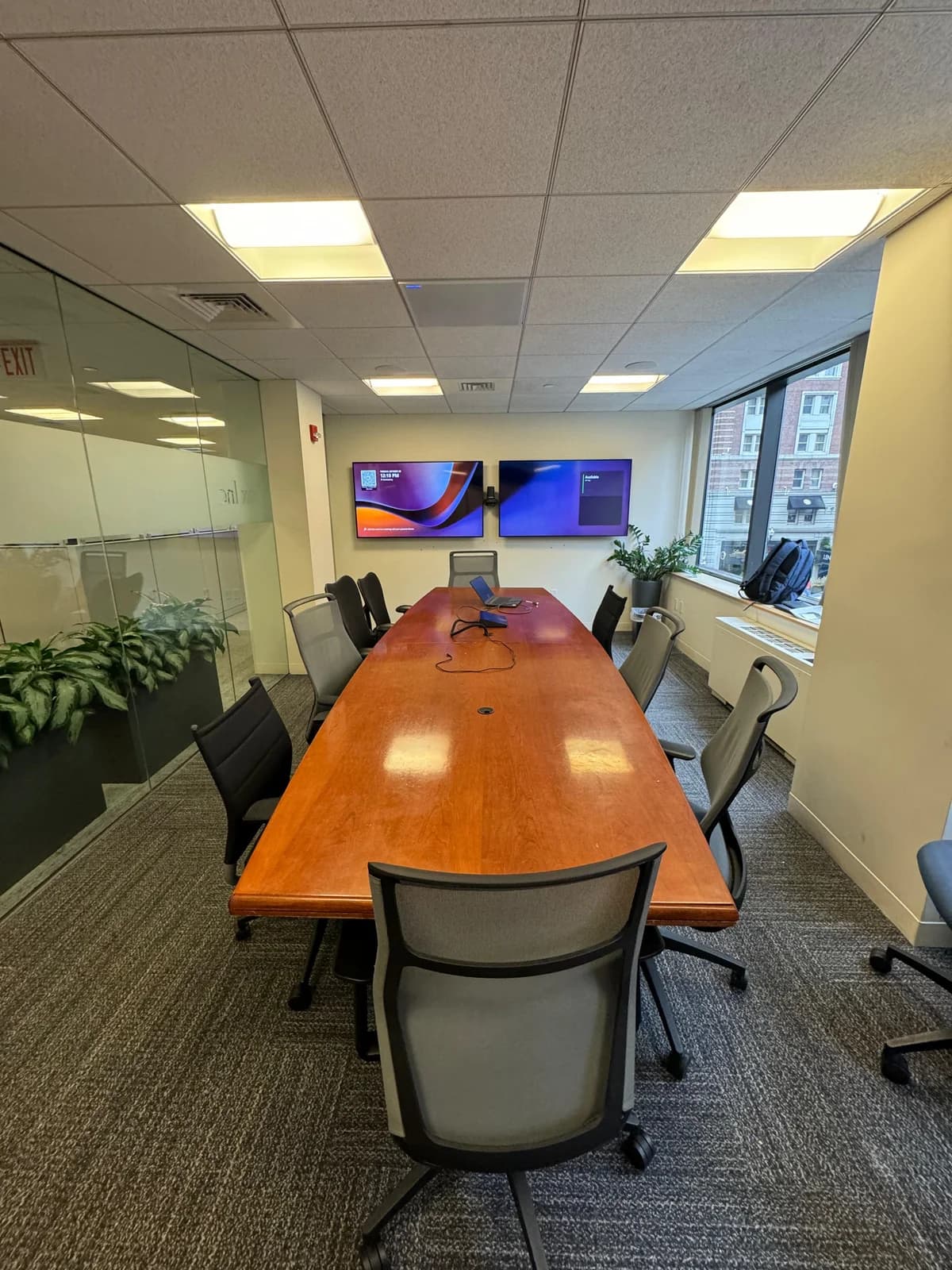
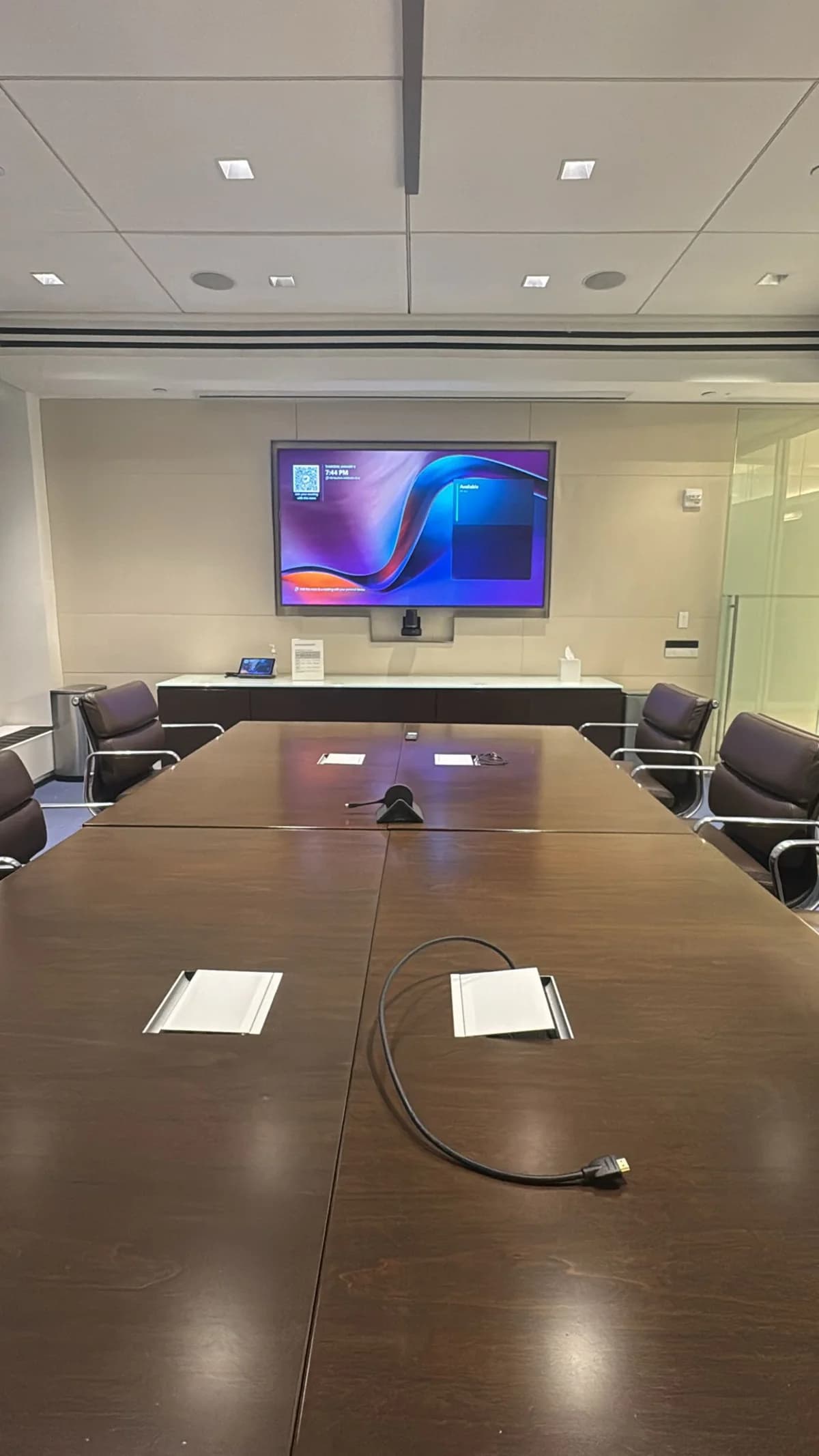
Meeting spaces are their own category. A conference room display is rarely just a screen — it's one piece of a system that includes cameras, microphones, speakers, and a control interface so anyone can walk in and start a video call. We cover this in depth further down, and in our guide to conference room AV installation costs.
Industries We Serve
Commercial AV needs vary widely by industry. Here's where our work most often lands:
| Industry | Typical projects |
|---|---|
| Offices and coworking | Reception displays, huddle rooms, conference rooms, boardrooms, town-hall screens |
| Restaurants and bars | TVs above the bar, sports-viewing layouts, digital menu boards |
| Retail | Storefront displays, product video loops, in-aisle signage, video walls in flagships |
| Gyms and fitness studios | Cardio-deck screens, class-schedule signage, lobby displays |
| Lobbies and building management | Directory and wayfinding screens, branded video walls, tenant-information displays |
| Medical and dental | Waiting-room TVs, patient-education displays, check-in signage |
| Hospitality | In-room and common-area TVs, event-space displays, restaurant and lounge screens |
If your space isn't on this list, it doesn't mean we can't help — the underlying skills carry across every commercial environment.
Why Commercial Differs From Residential
This is the part many business owners underestimate. A commercial install is not a bigger home install. It's a different job with different constraints.
Heavier Displays and Structural Mounting
Commercial displays are frequently larger and heavier than anything you'd hang at home. Video walls multiply that weight across a single mounting structure. A residential mount finds a couple of studs and calls it done. A commercial mount often means anchoring into concrete, brick, or block — sometimes building a backing structure — and always selecting hardware rated well beyond the load. A screen coming off a lobby wall is not an option.
Cable, Conduit, and Code
In a home, hiding a cable usually means routing it inside drywall. In a commercial building, the wall is often masonry, the run is often longer, and cabling may need to travel through conduit to satisfy building requirements. Surface-mounted raceway or proper conduit is frequently the right answer, and the routing has to be planned before anything goes on the wall.
Scheduling and Phased Work
A working office, busy restaurant, or open retail floor cannot stop for an install. We work every day, 9 AM to 6 PM, weekends included, and larger jobs can be phased so the business keeps running. We plan installs around your operating hours rather than the other way around.
Building Management Coordination
This is where NYC adds its own layer. Older and landmark buildings, freight-elevator scheduling, loading-dock windows, approved-vendor lists, and certificate-of-insurance requirements all shape how and when a job can happen. We coordinate directly with building management so the install clears every requirement before our team shows up — no wasted trips, no surprises at the loading dock.
Insurance and COI
Many commercial buildings in New York ask for a Certificate of Insurance (COI) naming the building before work begins. We carry $2M general liability and a separate $5M umbrella policy and provide a COI as a standard part of every commercial project. More on that in the FAQ.
Our Process: Site Visit to Support
Commercial projects run on a clear, repeatable process. Here's how a typical engagement goes from first call to finished room:
- Discovery and project request. You tell us about the space, the goal, and any building constraints by submitting a project request or calling (646) 912-5050. Corporate AV routes into our quote flow rather than a fixed-price checkout.
- Site visit. We come and look at the space — wall construction, power and data locations, viewing angles, display sizes, building access rules, and any COI or freight-elevator requirements.
- Design and quote. We design the system and mounting approach, then send a detailed quote. For corporate AV, equipment is included in the quoted price, and the quote lists it before any work begins.
- Building coordination. We submit insurance documents, book freight-elevator and loading-dock windows, and schedule around your operating hours — including weekend work where needed.
- Installation. Our team handles structural mounting, cable and conduit runs, display and AV setup, alignment, and a full functional test before we leave.
- Walkthrough and support. We walk you through how to use the system and stay available for support, calibration, and future expansion as your space grows.
Each step is built to remove the friction that derails commercial jobs — the surprise wall type, the missing COI, the elevator that was never booked.
Conference Room and Boardroom AV
Meeting spaces deserve their own focus because the display is only the visible tip of the system. A room that "just works" for video calls combines a display, a camera tuned to the room, microphones that pick up everyone at the table, speakers, and a simple control interface — all integrated so a meeting starts with one tap.
We design and install these systems end to end:
- Video conferencing room setup — huddle rooms and standard conference rooms built for reliable daily video calls
- Conference room AV installation — full meeting-room systems with display, camera, audio, and control integrated
- Boardroom AV — executive boardrooms and town-hall spaces with premium audio coverage, multiple displays, and presentation control
If you're early in planning, our buyer's guides are a good starting point: the video conferencing systems buyer's guide and the walkthrough on how to set up a conference room for video conferencing. Businesses building out screening rooms or executive lounges may also be interested in home theater installation, which uses the same calibration and acoustic expertise in a commercial setting.
What It Costs
Commercial and corporate AV is quote-based because no two spaces are alike. As a planning reference, our corporate AV projects start from the following — with equipment included in the price:
| System | Starting from |
|---|---|
| Huddle room video conferencing | From $5,000 |
| Standard conference room AV | $5,000 |
| Boardroom AV | From $10,000 |
| Town-hall / large-room AV | $10,000 |
These are starting points, not fixed prices. Your final quote depends on room size, displays, audio coverage, wall construction, cable and conduit runs, and your building's access and insurance requirements. Equipment is included in the quoted price — you're not buying hardware separately.
Simple single-display commercial mounts can sometimes be booked directly. But the moment a job involves a video wall, integrated AV, masonry mounting, or multiple screens, it becomes a custom quote. The fastest path either way is to submit a project request — corporate AV automatically routes to our quote flow — or call us at (646) 912-5050 to talk it through.
A clean, well-built display system is one of the most visible investments a business makes in its space. It's worth getting right the first time, with a team that knows how NYC buildings work.
Frequently Asked Questions
Do you provide a Certificate of Insurance (COI) for commercial jobs?
Yes. We carry general liability and umbrella insurance and provide a Certificate of Insurance for building management as a standard part of any commercial project. Most NYC buildings require a COI naming the building before any contractor can work on site. We handle that paperwork up front as part of building coordination. If your management company has a specific COI format or additional-insured language, send it to us early and we'll make sure the certificate meets their requirements before the install date.
Can you mount large displays on concrete, brick, or masonry walls?
Yes. A large share of NYC commercial spaces have masonry, concrete, or brick walls rather than drywall, and we mount into all of them using hardware rated well above the display's weight. For very large displays or video walls, we sometimes build a backing structure to carry and distribute the load. We assess the wall during the site visit so the mounting approach is locked in before we order hardware or schedule the install.
Can you work around our opening hours so we don't have to close?
Yes. We work every day, 9 AM to 6 PM, weekends included, so we can pick a day that keeps a working office, restaurant, or retail floor open. Larger projects can also be phased across multiple visits. We plan the schedule around your operating hours and your building's freight-elevator and loading-dock windows.
Will you coordinate with our building management?
Yes — and we treat it as a core part of the job. NYC buildings have approved-vendor lists, freight-elevator reservations, loading-dock windows, and insurance requirements that all have to line up before work begins. Older and landmark buildings often add their own rules. We coordinate directly with building management to submit the COI, book access windows, and confirm any building-specific requirements so the install goes smoothly the first time.
How is commercial pricing determined?
Commercial and corporate AV is quote-based rather than fixed-price. After a site visit, we design the system and send a detailed quote that accounts for room size, displays, audio, wall construction, cable and conduit runs, and your building's access and insurance requirements. Equipment is included in the quoted price. Conference room systems start from $5,000 for a huddle room and $5,000 for a standard conference room, boardrooms from $10,000, and town-hall rooms from $10,000 — all starting points that your final quote builds on.
Do you install video walls and digital signage, not just single TVs?
Yes. We install single displays, multi-display layouts, tiled video walls, and digital signage and menu boards. Video walls and signage are always custom projects because they involve precise panel alignment, structural mounting, and video processing or media playback behind the screens. Tell us what you're trying to display and where, and we'll design the right setup. Submit a project request or call (646) 912-5050 to get started.