Yes — you can mount a TV without studs, but only with the right anchor and mount type for your wall.
Who's this for: anyone whose stud finder gave up, whose studs are in the wrong place, or whose TV needs to go on a wall with no stud nearby.
This guide covers drywall toggle anchors, plaster wall technique, size limits, and when to call a pro instead.
The short answer
- Drywall: use toggle anchors — they spread the load behind the wall. Works up to 65 inches.
- Plaster: drill at a slight downward angle with the right screws. Fixed or tilting mount only, max 65–75 inches.
- Concrete or brick: not a DIY job. Needs masonry anchors and a hammer drill.
- Mount type: fixed or tilting only — never full-motion without studs.
- TV size cap: 65 inches for DIY. Anything bigger needs a professional assessment.
- Pro installation starts at $175 — less than the cost of a dropped TV.
The rules: what works and what doesn't
Before you buy hardware or drill a single hole, know these limits.
Mount type: fixed or tilting only. A full-motion mount puts huge leverage on anchor points when the arm extends. Without studs to absorb that force, the anchors can pull out over time. Want full-motion without studs? That's a job for a pro.
TV size: 65 inches or smaller for DIY. A 75-inch TV on a wall without studs needs a professional to assess the right approach. The weight and size create too much stress for anchor-only mounting.
Wall type matters. Toggle anchors work in drywall. Plaster needs a different technique. Concrete and brick need masonry anchors and a hammer drill — not a DIY job.
Drywall: toggle anchors
Toggle anchors are the right tool for drywall when there's no stud. You drill a hole, push the anchor through, and a metal toggle springs open behind the wall to grip. Each anchor holds significant weight when installed correctly.
How to install toggle anchors
- Mark your bracket holes on the wall using a level. Precision matters — the hole can't move once drilled.
- Drill the pilot holes. Use the size on the anchor packaging — usually ½ inch for TV mount toggles.
- Insert the toggle anchor through the hole. Push until the toggle clicks open behind the wall.
- Tighten the bolt. Pull the bolt toward you while tightening so the toggle seats flat against the back of the wall.
- Mount the bracket and hang the TV.
Use all 4 mounting holes on your bracket — not just 2.
Want to see it done? Search YouTube for "how to use toggle anchors for TV mounting" — there are good step-by-step videos showing the full process.
What toggle anchors are NOT for
- Full-motion mounts — the lateral force when the arm swings will pull anchors out over time
- Plaster walls — the brittle surface cracks and the lath (wood strips) behind it isn't reliable for toggle grip
- Concrete or brick — toggles need a hollow wall cavity to work
- TVs over 65 inches
Plaster walls: downward angle technique
Plaster is common in pre-war NYC apartments. It's dense, brittle, and completely different from drywall. Standard toggle anchors don't work well because the plaster can crack and the lath behind it isn't always solid.
For plaster, use this technique:
- Fixed or tilting mount only — no full-motion
- Drill at a slight downward angle — helps the anchor grip both the plaster and the lath behind it
- Use a 7/16-inch drill bit for the pilot hole
- Screws at least 2 inches long — they need to pass through the plaster and bite into the lath
- Drill slowly — plaster cracks if you rush. Use a carbide-tipped bit at low speed
Size limit for plaster: 65–75 inches max. Plaster is less forgiving than drywall. Anything 75 inches or larger on plaster needs a professional.
Important: Every plaster wall is different. If the plaster feels soft, crumbly, or has visible cracks, don't DIY — the wall needs a professional assessment before you mount anything.
When to call a pro
A falling TV damages your wall, destroys the TV, and can injure someone. Call a professional if:
- Your TV is 75 inches or larger
- You want a full-motion (articulating) mount
- Your wall is concrete or brick — masonry anchors require the right drill and technique
- Your plaster is crumbling or has been patched before — previous repairs are weak spots
- You're not comfortable drilling or don't have the right tools
- Your building requires a Certificate of Insurance (COI) for wall work — we provide COIs to any building that asks
Professional installation starts at $175. That's a fraction of replacing a destroyed TV or repairing a collapsed plaster wall.
What a professional installation looks like
When we mount without studs, we know the wall type, we choose the right hardware, and we verify load capacity before committing.
A typical professional no-stud installation:
- Wall assessment — identify wall type, check thickness, probe for weak spots
- Weight calculation — TV plus mount, factoring in arm extension if applicable
- Hardware selection — the correct anchor type and rating for your specific wall
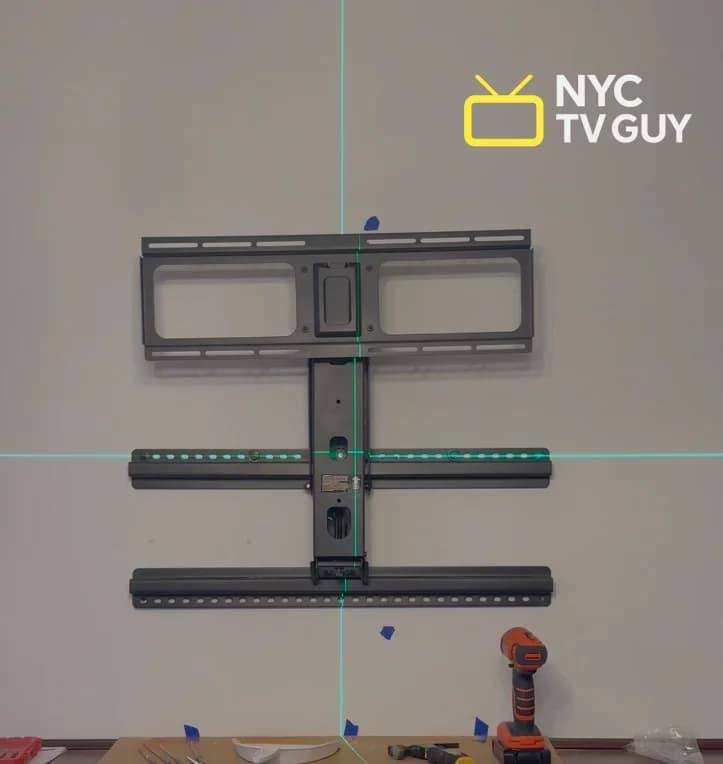
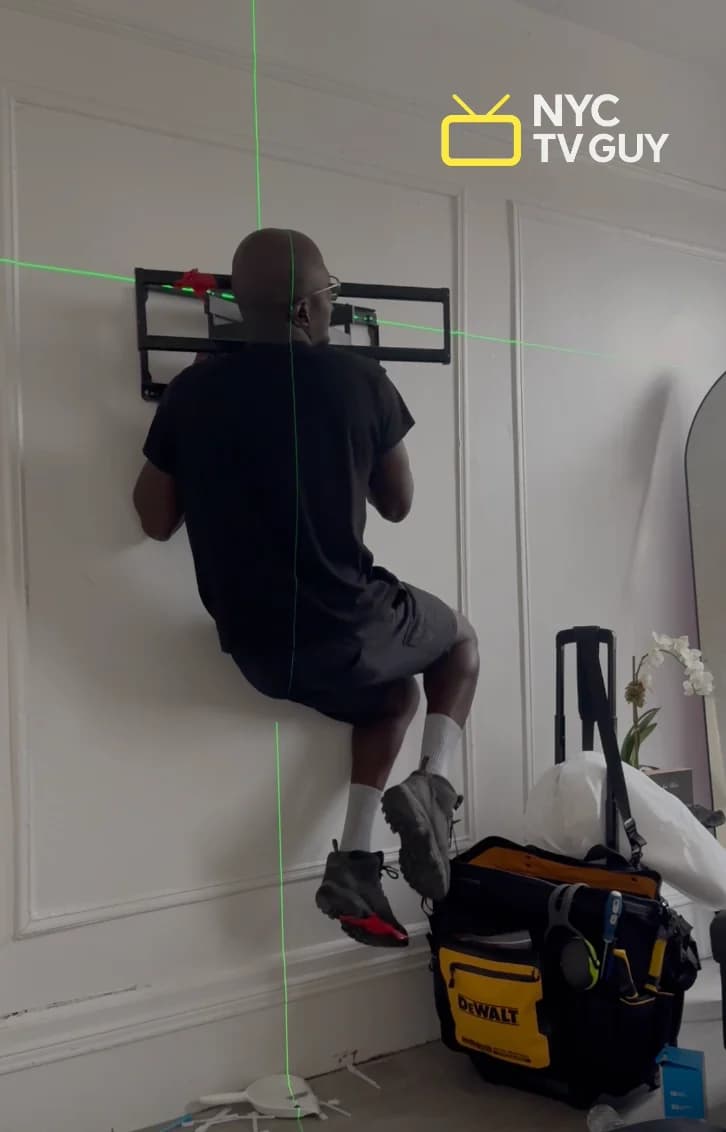
- Precise layout — level and mark so every anchor lands in a structurally sound spot
- Clean installation — correct depth, perpendicular angle, level mount
- Load test — physically test the mount before hanging the TV
The whole job typically takes 60–90 minutes.
Our TV mounting services
| Service | Price | What's included |
|---|
| TV Mounting | $175 | Labor, stud finding, mounting hardware (screws, anchors), leveling. You provide the TV and mount bracket. |
| TV Mounting + Cables Covered | $199 | Everything above + paintable cable raceway so no wires are visible |
| TV Mounting + In-Wall Power & Cable | $599 | Everything above + power outlet behind the TV and cables routed inside the wall (drywall only) |
Need a mount bracket? Check our equipment recommendations — we list the best fixed and tilting mounts for every TV size.
We serve Manhattan, Brooklyn, Queens, the Bronx, Staten Island, and parts of New Jersey. Book your installation or request a quote if you want us to assess your wall first.
FAQ
Can you mount a 65-inch TV without studs?
Yes. In drywall, with toggle anchors and a fixed or tilting mount, a 65-inch TV can be mounted safely without studs. That's the upper limit we'd recommend for DIY. Use all 4 mounting holes and don't use a full-motion mount.
Can you mount a 75-inch TV without studs?
We wouldn't recommend DIY at 75 inches without studs. The weight and size create too much stress for anchor-only mounting. Book a professional installation — we'll assess your wall and find the safest approach, which may include finding studs in a nearby location.
What about no-drill TV mounts?
We don't recommend them. They drive nails into the drywall to distribute weight, but they're harder to level and more accident-prone. Toggle anchors are more secure and more reliable — use those instead.
Can I mount a TV on a plaster wall without studs?
Yes, but the technique is different. Drill at a downward angle with a 7/16-inch bit, use 2-inch screws, and go slowly to avoid cracking the plaster. Fixed or tilting mount only, max 65–75 inches. If the plaster is old or crumbly, get a professional assessment first. Our TV mounting service starts at $175.
Do I need to hide the cables after mounting?
You don't have to, but it looks much better. A paintable cable raceway is the easiest option — it covers the wires without extra wall work. If you want full in-wall cable routing (drywall only), our cables-in-wall service handles everything for $599.
Will my building need a COI?
Some NYC buildings require a Certificate of Insurance before allowing wall work. We carry general liability and umbrella insurance and provide a COI to any building that requests one — just let us know when you book and we'll have it ready.
Mounting without studs is doable — as long as you respect the limits. Fixed or tilting mount, toggle anchors in drywall, proper technique in plaster, and nothing over 65 inches for DIY.
If your setup falls outside those limits — or you just want it done right without the stress — book a professional installation starting at $175. We handle no-stud mounts every week across NYC and NJ.