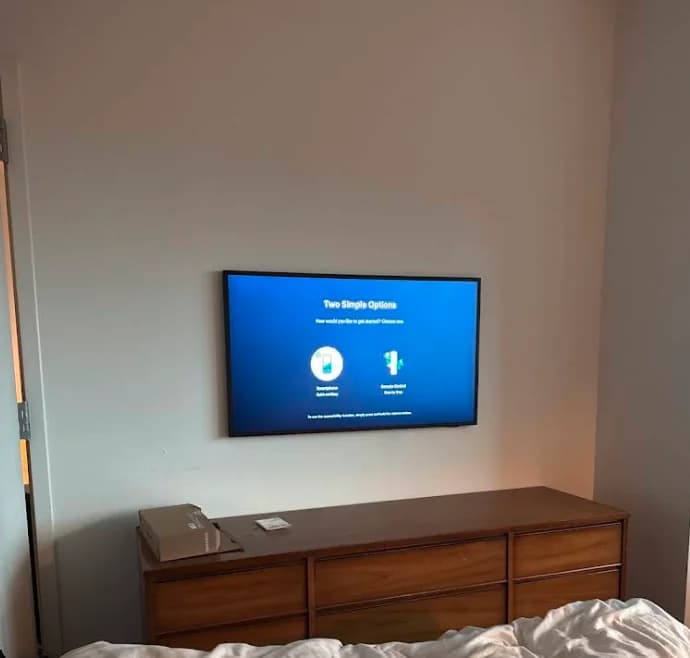
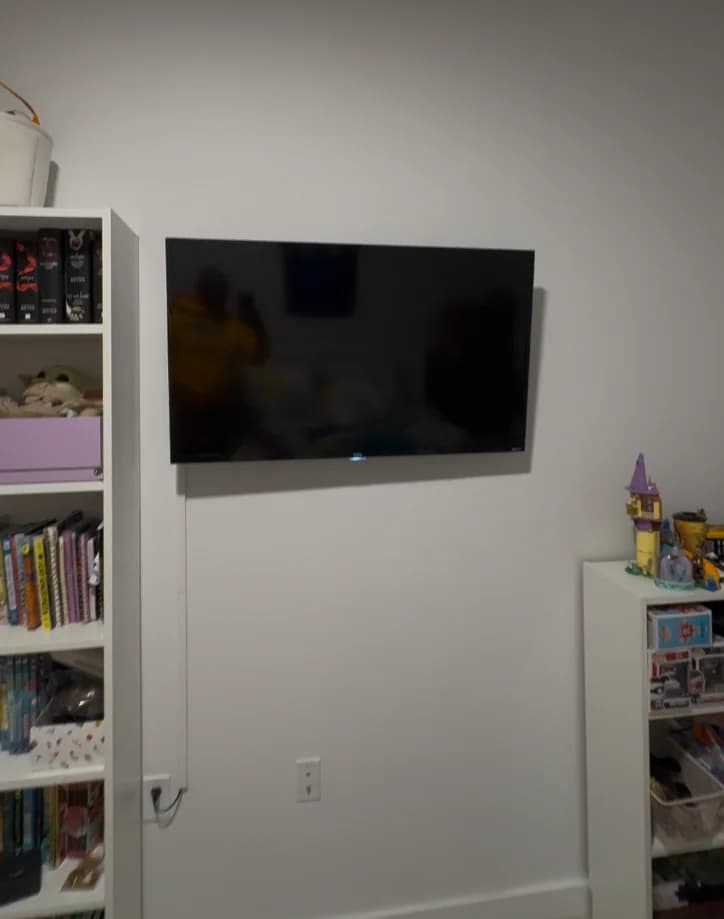

Owners on Reddit say to hide the cables before a child pulls them, and that a TV mounted high may need a tilt toward the seat. Read what owners say ↓
What owners on Reddit say
"Conceal those cables in the wall or in a track before the kid yanks them." — one commenter, r/hometheater (thread)
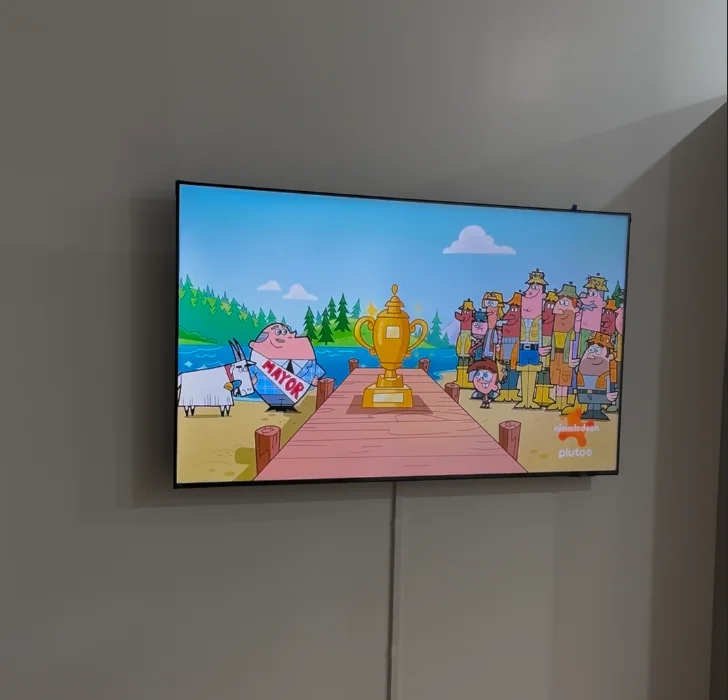
"If you took that photo from eye level while sitting on the couch, then technically it is slightly higher than what you'd want. … Tilting is the workaround hack when mounting TVs higher up on the wall." — one commenter, r/hometheater (thread)
A higher TV is safer from small hands. Check the height from where your child sits, and cover every cable.
Who's this for: parents setting up a TV in a kids room who want to know the right height, which mount to use, and how to handle cables safely.
This guide covers height, TV size, cable safety, mount type, and when to call a pro.
On this page
Mount it higher than usual
In a living room, you want the TV at eye level while seated — about 42–48 inches from the floor. In a kids room, mount it higher — around 5 to 6 feet from the floor.
The goal is to keep the screen out of reach. Kids throw things, swing toys, and bump into walls. A higher mount keeps the screen safe from accidental damage.
Bonus: kids watching from bed look upward naturally. That's actually a comfortable viewing angle — they're not craning sideways at a low screen.
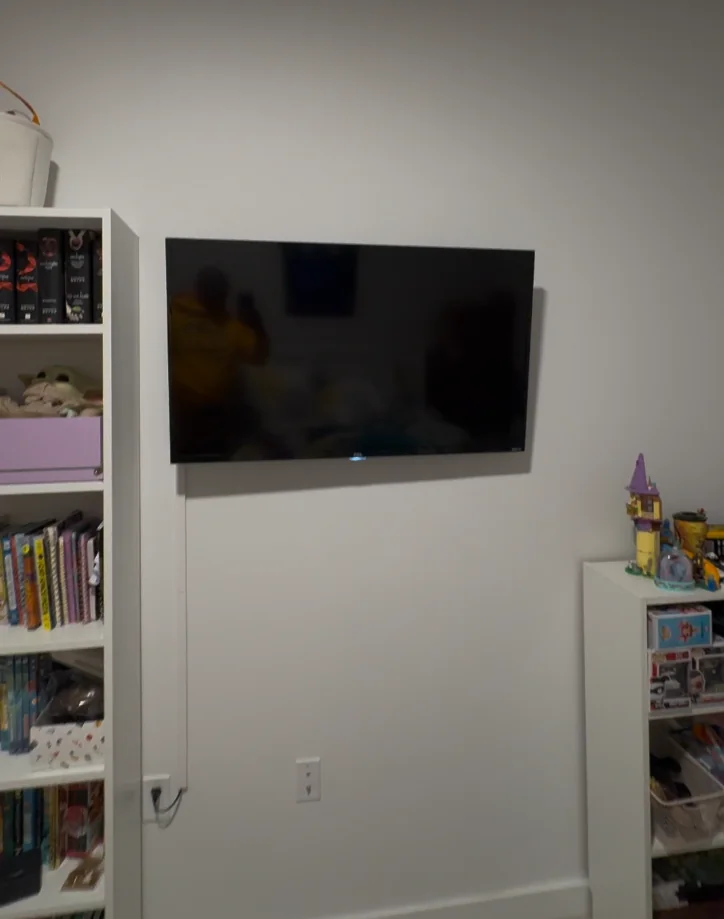
You don't need a big or expensive TV
A kids room doesn't need anything bigger than a 43-inch TV. Most kids do fine with a 32-inch screen, and it is one of the least expensive sizes. Get a smart TV with built-in streaming so they can watch YouTube, and add a game console if they want.
Don't spend big here. Kids are rough on things, and there's a real chance the screen gets scratched or cracked eventually. A budget 32-inch TV mounted safely on the wall is the right move.
Cover the cables
Kids grab things. If cables hang between the TV and the outlet, a child can pull on them — and that can damage the TV's ports or yank a cable out of the wall.
Every cable in a kids room needs to be covered. Two options:
- Cable raceway: A flat cover that mounts on the wall and hides all the cables. Works on any wall type. This is our TV Mounting + Cables Covered service — starting from $199.
- In-wall routing: All cables run inside the wall with a new outlet behind the TV. Zero visible wires. This is our TV Mounting + Power Outlet + Cable in Wall service — from $599. Drywall only.
Either way — no free-hanging cables in a kids room.
Use a fixed (flat) mount
Use a fixed mount in a kids room. It holds the TV flat against the wall with no moving parts — nothing to grab, nothing to hang from, nothing to swing around.
Full-motion mounts have an arm that extends and swivels. In a kids room, that arm sits right at play height. Kids will treat it like a toy. A fixed mount is simpler, safer, and more stable.
When to call a pro
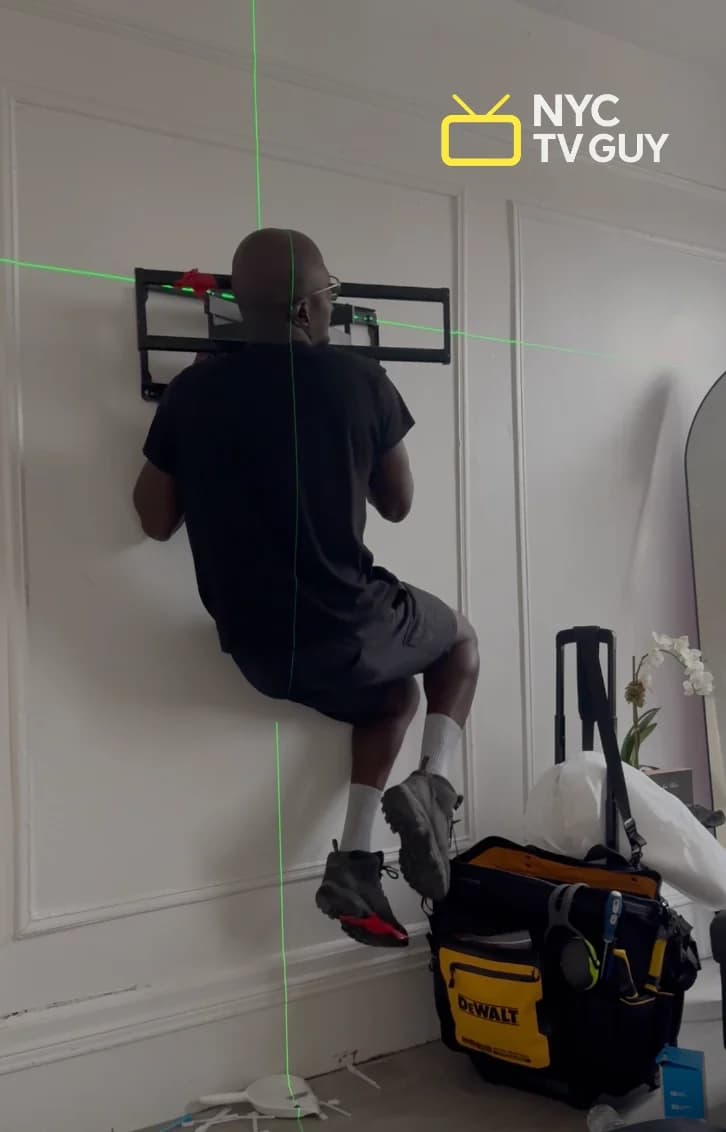
Getting the height right, covering the cables properly, and anchoring the mount solidly into studs — that's where professional installation pays off. Especially in a kids room where safety matters more than aesthetics.
We do kids room TV installations throughout NYC. Book online — TV mounting starts from $175.
Frequently Asked Questions
Should I mount the TV higher in a kids room?
Yes. Mount it around 5 to 6 feet from the floor so it's out of reach. Kids throw things, swing toys, and bump into walls — a higher mount keeps the screen safe from accidental damage.
What size TV is best for a kids room?
32 to 43 inches is plenty. A solid 32-inch smart TV is one of the least expensive sets you can buy. Save the big screen for the living room — kids don't need it, and they're more likely to damage it.
Do the cables need to be covered?
Absolutely. Kids will pull on hanging cables. Use a cable raceway to cover them, or run them through the wall for the cleanest look. No free-hanging cables in a kids room.
What type of mount should I use?
A fixed (flat) mount. It holds the TV flush against the wall with no moving parts. Full-motion mounts have arms that extend out — kids will grab them and swing on them. Keep it simple and flat.
What if the wall is concrete or brick?
No problem — we mount on all wall types. Concrete and brick require masonry anchors and a hammer drill, but the job is the same from your end. Just let us know your wall type when you book online and we'll come prepared.